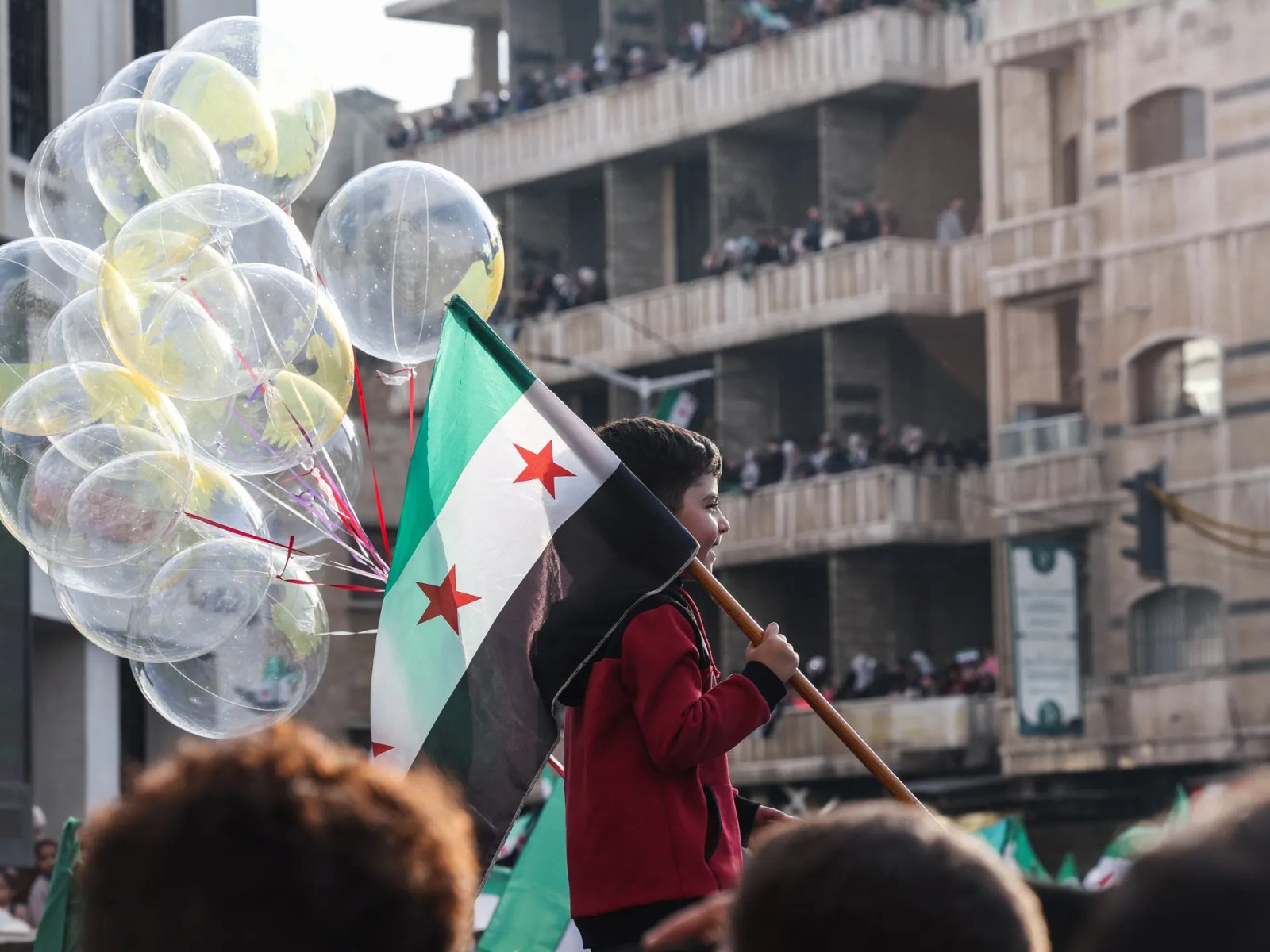
Syrians gathered to celebrate days before the December 8 anniversary, which will mark the day the capital was liberated.
Damascus, Syria – Around Damascus’s Umayyad Square, children leaned out the windows, waving Syria’s green, white and black flag as fireworks burst in the sky.
December 8, the anniversary of liberation for the capital and the country as a whole, was two days away, but crowds had already begun to gather in the square.
Nearby, standing alone and watching the festivities, stood Abu Taj, 24. Ten years earlier, he had left his home in the Aleppo countryside when his house was destroyed in fighting between the regime and anti-Assad forces.
From there, he fled to Damascus and then Beirut before flying to join his father in Saudi Arabia.
After a decade in exile – eight years in Saudi Arabia and two years studying in Egypt – Abu Taj moved back to Syria. He arrived just more than a week before people from all over the country gathered to celebrate the operation that stormed Damascus and forced Bashar al-Assad to flee, in the early hours of the morning, to Moscow.
On the last Friday before the anniversary, Abu Taj prayed at the Umayyad Mosque before coming down to Damascus’s main meeting point to see the festivities.
With it fell a brutal police state, notorious for its use of torture and disappearance.
For many in Syria, the regime’s collapse brought with it an exhalation – the first in decades since Bashar’s father Hafez came to power in 1970.
The early days following the liberation were marked by elation in many parts of Syria, but also by concern over what was to come.
Early predictions looked to the examples of Iraq after the US invasion or Libya after the fall of the Gaddafi regime.
Few expected that the severe US sanctions on Syria would be removed, especially with Ahmed al-Sharaa, a man once with a US ransom on his head, leading the new government.
Exhalation
Tragedy did, however, follow when widespread sectarian violence took place along the Syrian coast in March and again in Suwayda in July.
In both instances, forces said to be aligned with the Syrian government inflamed tensions, with revenge killings and sectarian targeting of minorities.
Across the city, the green, white and black flag is on ubiquitous display. Outside the Umayyad Mosque, children’s faces are painted with the vertical green, white and black blocks, while in Marjeh Square, locals unpacked a bag of flags to sell or distribute.
Omran, a 22-year-old from Deir Az Zor in Syria’s northeast, sat smoking hookah in Marjeh Square with his younger brother, Bahaeddine, and his mother. He recently returned to Syria from Lebanon and said he hadn’t seen his mother in nine years.
He said he plans to go to Umayyad Square on December 8 to participate in the celebrations with his mother and his younger brother. “We will all be so happy, thank God,” he said.
While most of the city is decked out in flags and decorations, Umayyad Square is where the heart of the celebration will take place.
Celebrations started Friday afternoon as thousands of young men and women in minivans or on scooters headed to the city’s historic roundabout, where the wreckage from an Israeli strike on the Ministry of Defence in July is still visible.
Abdelaziz al-Omari, 21, from the Palestinian camp of Yarmouk, stood next to two friends in the roundabout. He waved a long pole holding the Syrian and Palestinian flags.
“We came here today to celebrate the anniversary of the liberation,” he told media.
“We were oppressed, but now our sadness has been released.”
The celebrations carried on – with cars honking and fireworks exploding – until the early hours of Saturday morning.






 United Arab Emirates Dirham Exchange Rate