
Flooding has become the world’s ‘foremost climate hazard’, according to experts. So what do we do about it?
Devastating floods ravaged multiple regions of the world in 2025, from Southeast Asia to North America and the Middle East.
We asked climate experts what is causing the devastation and what governments should be doing to prevent the situation from becoming even worse in the coming year.
“Throughout 2025, a series of major floods occurred worldwide, making flooding the year’s foremost climate hazard,” Pawan Bhattarai, assistant professor at the civil engineering department of Nepal’s Kathmandu-based Tribhuvan University, told media.
Here is a recap of some of the major floods that took place.
Heavy downpours and freezing temperatures continue to ravage Gaza, where nearly 2 million people have been displaced during two years of Israeli bombardment that has destroyed much of the Strip.
Many people in Gaza are living in tents amidst rubble from destroyed homes and are largely unprotected from the strong winds and rain.
On Saturday, a polar low-pressure weather system carried particularly heavy rain and strong winds to the Gaza Strip. According to meteorologist Laith al-Allami, this is the third such system to affect the territory in the past few weeks, with a fourth which hit on Monday, Anadolu Agency reported.
One of the previous two was Storm Byron, which brought heavy rainfall and strong winds to Gaza as well as parts of Israel and the wider eastern Mediterranean region earlier this month.
Earlier this month, Morocco launched a nationwide emergency relief operation to support people affected by severe flooding as the country battled freezing conditions, torrential rains and snowstorms.
Flash floods killed at least 37 people and damaged about 70 homes and shops in the town of Safi, 300km (186 miles) south of the capital, Rabat.
Prosecutors are investigating whether shortcomings in infrastructure, such as poor drainage, played a role in the disaster.
Which places were worst hit by floods in 2025?
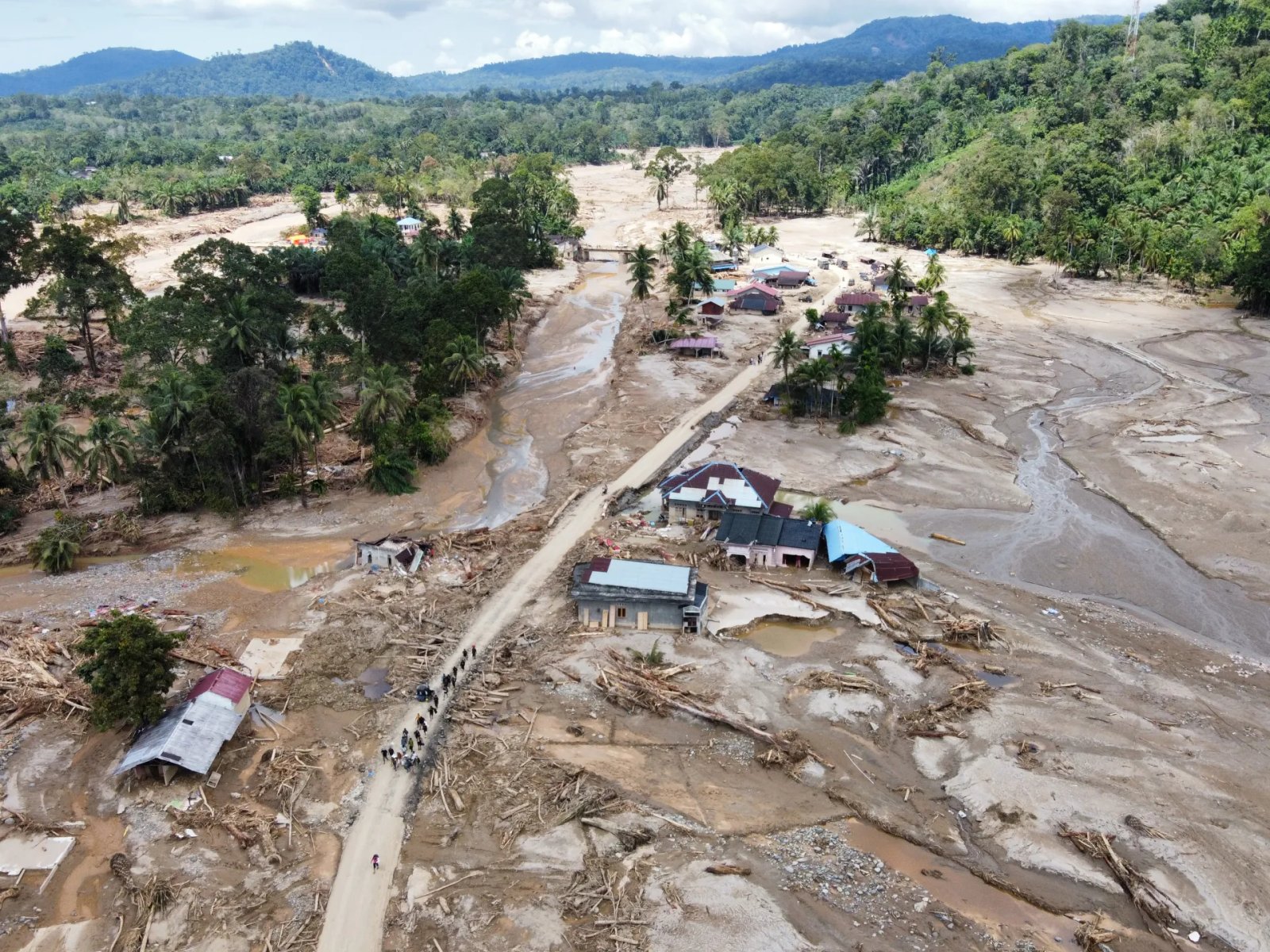
Floods hit Indonesia in December, killing at least 961 people in Aceh, North Sumatra and West Sumatra. More than 20 villages across the three provinces were completely swept away by the floods.
Homes, rice fields, dams and bridges were destroyed, leaving many areas inaccessible.
At least 276 people have been killed in flooding in Thailand in December. The floods badly affected eight provinces in the central plains, four in the south and two in the north, according to the Thai Department of Disaster Prevention and Mitigation.
In late November, floods and landslides killed at least 56 people as Cyclone Ditwah, a deadly tropical storm, swept across Sri Lanka.
The heavy downpour which accompanied the storm destroyed four houses and damaged more than 600. It also caused trees and mud to fall and block multiple roads and railway lines.
Sri Lankan President Anura Kumara Dissanayake, who took office in September 2024, inherited painful austerity measures imposed by his predecessor, Ranil Wickremesinghe, as part of a bailout loan package from the International Monetary Fund (IMF), hampering rescue efforts.
“The storm poses a significant challenge to the government that is just beginning to address the social and economic concerns of the people,” Ahilan Kadirgamar, a senior lecturer at the department of sociology, University of Jaffna in Sri Lanka, told media in November.
In October, severe floods and landslides hit parts of Nepal and India’s eastern Himalayan city of Darjeeling, killing at least 50 people.
This year’s rainfall was not record-breaking – overall, there was actually slightly less rain than in 2024, when the Kathmandu Valley saw its heaviest downpour since 2002. In the capital Kathmandu, some districts received just more than 145 mm of rain this year, compared with about 240 mm in late September 2024.
Damage was severe, however, because of “ultra-localised”, heavy rains.
The floods came one month after Nepal’s “Gen Z” protests in Kathmandu and other cities against corruption and nepotism. The protests prompted the deployment of the military and, ultimately, the resignation of Prime Minister KP Sharma Oli and his replacement by former Chief Justice Sushila Karki, 73, as interim PM.
While experts praised Karki for her interim government’s prompt early weather warnings before the flooding, widespread damage to critical infrastructure during the protests hindered rebuilding and relief operations.
“To prevent future disasters, a major shift in policy and practice is urgently needed. This must prioritise comprehensive watershed management, focusing on stabilising slopes and managing water run-off, which has been a persistently neglected area in our current approach to disaster risk reduction,” Bhattarai, the engineering professor, told media at the time.






 United Arab Emirates Dirham Exchange Rate