How Climate Change is Redefining Pakistan’s Weather Patterns
By Ghulam Haider
Over the past few decades, Pakistan has been confronting with an unsettling new reality—an era in which traditional weather patterns are disintegrating under the weight of climate change. This transformation is neither subtle nor distant, rather it has been violent, erratic, and, above all, deadly.
The recent weather events in April and May 2025 underscore the severity of this new climate normal. In a deeply disorienting turn of events, Islamabad and various parts of Punjab were pelted by an unseasonal and violent hailstorm in April.
Unprecedented in the history of the country, tennis ball sized or even greater Iceballs carpeted roads and damaged particularly wheat and other crops that were on the verge of harvest. As if that weren’t enough, just two days ago, a thunderstorm—ferocious in its intensity—swept through Islamabad followed by Punjab where it left 20 people dead, scores injured, and entire communities grappling with the wreckage of yet another climate-driven catastrophe.
These back-to-back events are not mere outliers. They are symptoms of a broader atmospheric malaise—one that is reshaping not just Pakistan’s meteorological patterns, but its very relationship with nature.
Pakistan’s geography has always rendered it vulnerable to extreme weather. From the snow-capped mountains of Gilgit-Baltistan to the parched plains of Sindh, the country traverses a spectrum of climatic zones. But what was once a strength—a diverse climate supporting multiple agricultural zones—is fast becoming a liability.
The Pakistan Meteorological Department (PMD) and international agencies like the World Bank and UNDP have issued warnings for over a decade: Pakistan is among the top 10 most vulnerable countries to climate change. Glaciers in the north are retreating. Sea levels are encroaching on the coasts. And the rhythm of the seasons—once the quiet heartbeat of rural life—has become increasingly erratic.
Traditionally, April marks the tail end of the spring season and the beginning of a steady transition into summer. But the freak hailstorm that hit Islamabad and parts of northern Punjab in April 2025 shattered expectations. Residents woke up to scenes more reminiscent of Europe’s alpine towns than a South Asian capital on the cusp of summer. Hailstones the size of golf balls smashed windows and crushed ripe wheat and mango blossoms, causing millions in losses to farmers who rely on this time of year to reap the fruits of months-long labor.
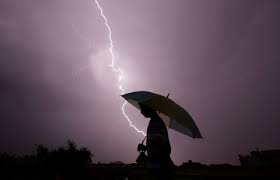
More recently, on May 23, 2025, a thunderstorm—accompanied by torrential rain, gale-force winds, and sporadic hail—barreled through the heart of Punjab and struck parts of Islamabad. Twenty people were killed, many of them crushed under collapsed roofs or electrocuted by falling power lines. Crops were flattened, streets turned into rivers, and in some areas, communication and power infrastructure were crippled for hours.
These storms aren’t just weather anomalies—they are examples of what scientists call “climate on steroids.” Warmer global temperatures inject more energy into the atmosphere. This increases the capacity of air to hold moisture and accelerates convection currents, leading to more intense storms. Simply put, warmer weather means more violent weather.
The increased frequency of unseasonal rainfall, hailstorms, and thunderstorms is evidence that Pakistan’s climate is becoming not just warmer, but more volatile. According to a 2023 report by the Intergovernmental Panel on Climate Change (IPCC), South Asia is now experiencing more frequent extreme precipitation events. What used to be “once-in-a-decade” deluges are now happening every few years—or in Pakistan’s case, multiple times within a single season.
The consequences extend beyond physical damage. Rural communities in Punjab and Khyber Pakhtunkhwa, who depend on crop calendars tied to the seasons, are now scrambling to adapt. Farmers who used to plant in October and harvest in April now find their entire production cycles upended. With each unseasonal rain or hailstorm, the risk of crop failure grows, threatening food security for millions.
Cities like Lahore, Faisalabad, and Islamabad are far from immune. Urbanization, poor planning, and outdated drainage systems mean that even moderate rainfall can paralyze city life. But with the intensity and unpredictability of recent weather events, the risks are exponentially higher.
In Islamabad, a city designed with spacious green belts and wide avenues, stormwater still flooded roads this week. Vehicles were stranded, trees were uprooted, and emergency services were stretched thin. With the frequency of such events increasing, there’s a growing urgency for climate-resilient urban planning—a priority that continues to be underfunded and overlooked.
To its credit, Pakistan’s government has acknowledged the crisis. Initiatives like the Ten Billion Tree Tsunami and Pakistan’s Nationally Determined Contributions (NDCs) to the Paris Climate Agreement mark positive steps. But implementation remains slow and fragmented. Climate resilience is rarely integrated into infrastructure, agriculture, or disaster response planning.
Moreover, Pakistan’s disaster response mechanisms remain reactive rather than proactive. The Pakistan Disaster Management Authority (PDMA) often finds itself racing against time, issuing warnings only hours before a deluge or hailstorm hits. Rural communities, lacking access to modern communication tools, are often the last to know and the first to suffer.
What’s needed is a comprehensive, forward-looking climate adaptation strategy. This includes early warning systems in local languages, community-based disaster preparedness, climate-resilient seed varieties, insurance safety nets for farmers, and urban infrastructure designed for extreme weather.
Behind every collapsed roof and every ruined field is a human story of loss. In central Punjab, media reports tell of a young boy killed when a brick wall fell on him during the May 23rd thunderstorm. A woman in Sargodha died while trying to salvage furniture as floodwater surged into her home. Farmers in Chakwal, where wheat crops were nearly ready for harvest, watched helplessly as their fields were shredded by hail.
These are not isolated tragedies. They are the human toll of a global phenomenon that Pakistan did little to cause, yet suffers disproportionately from.
Pakistan emits less than 1% of global greenhouse gases. Yet, it finds itself in the crosshairs of a climate crisis driven largely by industrialized nations. This moral and strategic imbalance is not lost on Islamabad, which has repeatedly called for climate justice at international forums.
But while international support—financial and technical—is critical, domestic action cannot wait. The events of April and May 2025 should be a clarion call. Pakistan must institutionalize climate thinking into all spheres of governance. Climate is no longer an environmental issue—it’s a development issue, a security issue, and above all, a survival issue.
The climate clock is ticking, and Pakistan finds itself standing at the edge of a storm—both literally and metaphorically. The hail in April and the deadly thunderstorm in May are not one-off freak events. They are harbingers of a more dangerous future—one in which weather grows less predictable, less forgiving, and far more lethal.
As Pakistan navigates this perilous terrain, it must do so with urgency and foresight. The skies are no longer dependable. The seasons no longer follow scripts. The only certainty is uncertainty—and the only way forward is resilience, adaptation, and relentless preparation.
The nation must brace itself—not just for the next storm, but for a future where the storm never really ends.



 United Arab Emirates Dirham Exchange Rate