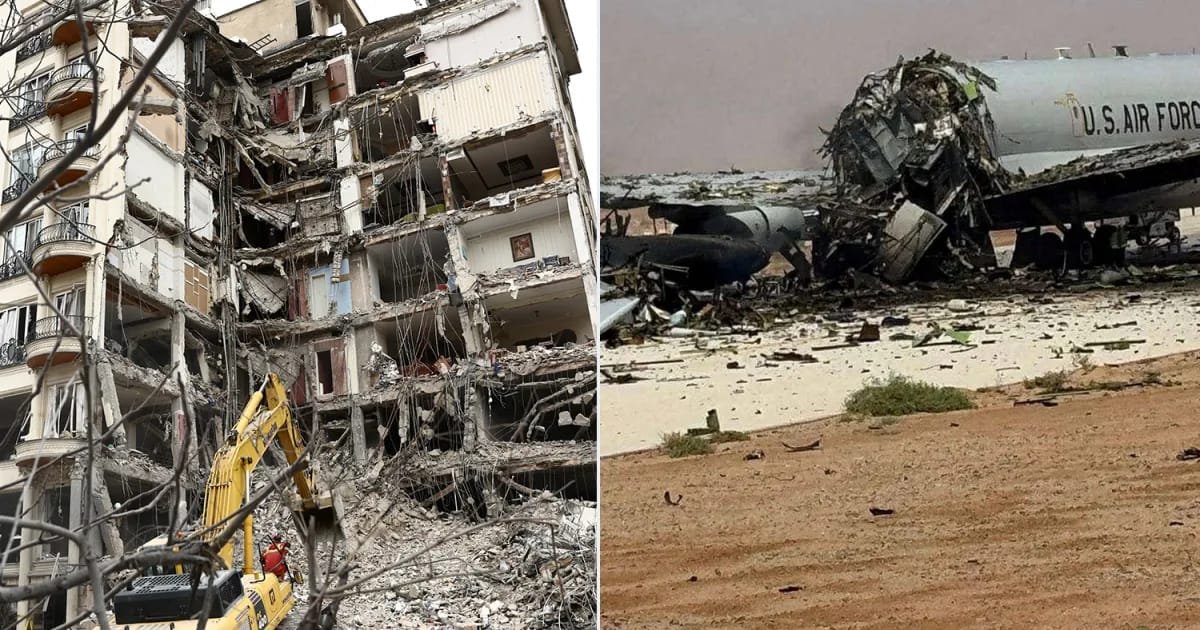
The US-Israeli campaign has failed to achieve its goals. Iran has been badly hit, and the Gulf is paying the bill too.
On the 40th day of the war that Washington called “Epic Fury” and Tehran named “True Promise 4”, United States President Donald Trump and Iran’s Supreme National Security Council accepted a Pakistani-brokered ceasefire. Two weeks of ceasefire — no missiles, no air strikes — and a promise that negotiators would meet in Islamabad on Saturday, April 11, 2026.
For the first time since late February, ships would be allowed to pass safely through the Strait of Hormuz. The ceasefire explicitly incorporates Iran’s 10-point peace proposal, and for the first time since the war began on February 28, the world has something resembling a diplomatic roadmap.
Yet before the architecture of this agreement is examined, it is worth pausing to assess the conflict itself: its origins, its legal standing, and who ultimately absorbed its costs.
This war did not emerge organically from the long arc of US-Iran confrontation that has defined Middle East geopolitics for 47 years. It was not the product of a specific Iranian act of aggression, nor did it follow the procedural frameworks that international law requires to justify the use of force. Rather, it was born from Israel’s strategic doctrine post-October 7, 2023 — what Israeli planners quietly described as “zeroing out threats” — a systematic campaign to neutralise perceived existential risks, of which Iran was considered the most consequential.
The US provided the military capacity. Israel provided the strategic rationale. Neither provided a United Nations Security Council mandate, a credible invocation of self-defence under Article 51 of the UN Charter, or any legal architecture that would satisfy the threshold requirements of international law. This was a war of choice. And, as with most wars of choice, it was presented to domestic and international audiences through the language of necessity and pre-emption.
The consequences were not difficult to anticipate. Iran — its military infrastructure degraded, its economy under mounting pressure — responded as any state controlling a critical geographic chokepoint might be expected to respond. The Strait of Hormuz was closed. An operation launched under the banner of regional security rapidly produced one of the most serious energy disruptions the global economy had experienced in decades, with reverberations felt across markets in Tokyo, Berlin and Sao Paulo.
Iran’s 10-point peace framework, now embedded in the ceasefire agreement, merits analysis on its own terms, rather than through the reductive lens that has often characterised Western commentary on Iranian diplomacy.
The proposal rests on several interlocking demands: a formal guarantee against future military attacks on Iranian territory; a permanent end to hostilities rather than a temporary suspension; a cessation of Israeli military operations in Lebanon; the lifting of US sanctions; and a halt to regional fighting involving Iranian allies. In return, Iran has committed to reopening the Strait of Hormuz, establishing a codified framework for safe maritime passage, splitting transit fees with Oman, and directing those revenues towards reconstruction rather than extracting reparations.
The proposed transit fee per vessel through Hormuz will attract criticism from the shipping industry and energy markets. That, however, must be weighed against the cost of 40 days of closure to global commerce. The fee represents a manageable operating cost. The alternative — an indefinitely closed strait — was not sustainable for any party, including Iran itself.
Among the most consequential and underexamined dimensions of this conflict is what it revealed about the evolving nature of Washington’s security role in the Gulf region. For decades, the US presented itself not merely as a military presence in the region, but as a strategic guarantor of stability for its Gulf partners — a security relationship premised on shared interests and mutual consultation.
Iran’s response unfolded across 10 simultaneous fronts. Its military operations — targeting US installations and, by Iran’s own account, facilities in neighbouring Gulf states that it alleged were being used in the campaign against it — inflicted an estimated $350bn in economic losses across the Arab Mashreq, the eastern part of the Arab world. Energy infrastructure, trade routes, and investor confidence were damaged, with the full impact likely to take years to quantify.
Intelligence assessments shared with the Trump administration before the escalation had apparently warned of this precise scenario: that military action against Iran would trigger retaliatory strikes against neighbouring states. Those assessments were either discounted or overruled. The Gulf states, which had sought to preserve stability and had no institutional voice in the decisions that led to this conflict, absorbed consequences when they had no role in initiating it.
This dynamic raises a question that Gulf policymakers will be compelled to address in the months ahead: whether Washington’s posture has shifted from that of a security partner to a security burden — one whose strategic decisions impose costs that others must absorb.
Iran’s 10 points: A framework worth serious examination
The declared objectives of “Epic Fury” were comprehensive: to degrade Iran’s military capability, to create conditions that would destabilise or collapse the Islamic Republic, and to establish a new regional security architecture aligned with Israeli and US interests. Measured against these objectives, the campaign fell short.
Iran’s military infrastructure sustained serious damage. Its nuclear programme was set back. Senior figures, including Supreme Leader Ayatollah Ali Khamenei, the upper tier of the Islamic Revolutionary Guard Corps, and National Security Council Secretary Ali Larijani, were killed in targeted strikes. These were significant tactical outcomes.
It is too early to fully assess the long-term implications of this conflict for Iran’s internal political stability. The elimination of senior leadership figures has produced a succession dynamic whose consequences will unfold over time. Whether the security establishment can sustain its hold on the Iranian state and society as it did before February 28, 2026 — when the war began — remains a genuinely open question.
What is not open to serious dispute is that the region has been structurally altered. The legal norms governing the use of force were strained, if not broken. Smaller states paid costs imposed by a confrontation they had no power to prevent. And the full accounting — in diplomatic capital, economic damage, and human loss — remains incomplete.
Ten points will not reverse 40 days of destruction. But if the Islamabad negotiations hold, and if both parties find the political discipline to honour what Pakistan helped broker, the strait may remain open, commerce may resume, and the international community may begin the slower and more difficult work of establishing accountability for an illegal war — and constructing, from its wreckage, something more durable than the order it replaced.
The views expressed in this article are the author’s own and do not necessarily reflect media’s editorial stance.





 United Arab Emirates Dirham Exchange Rate