
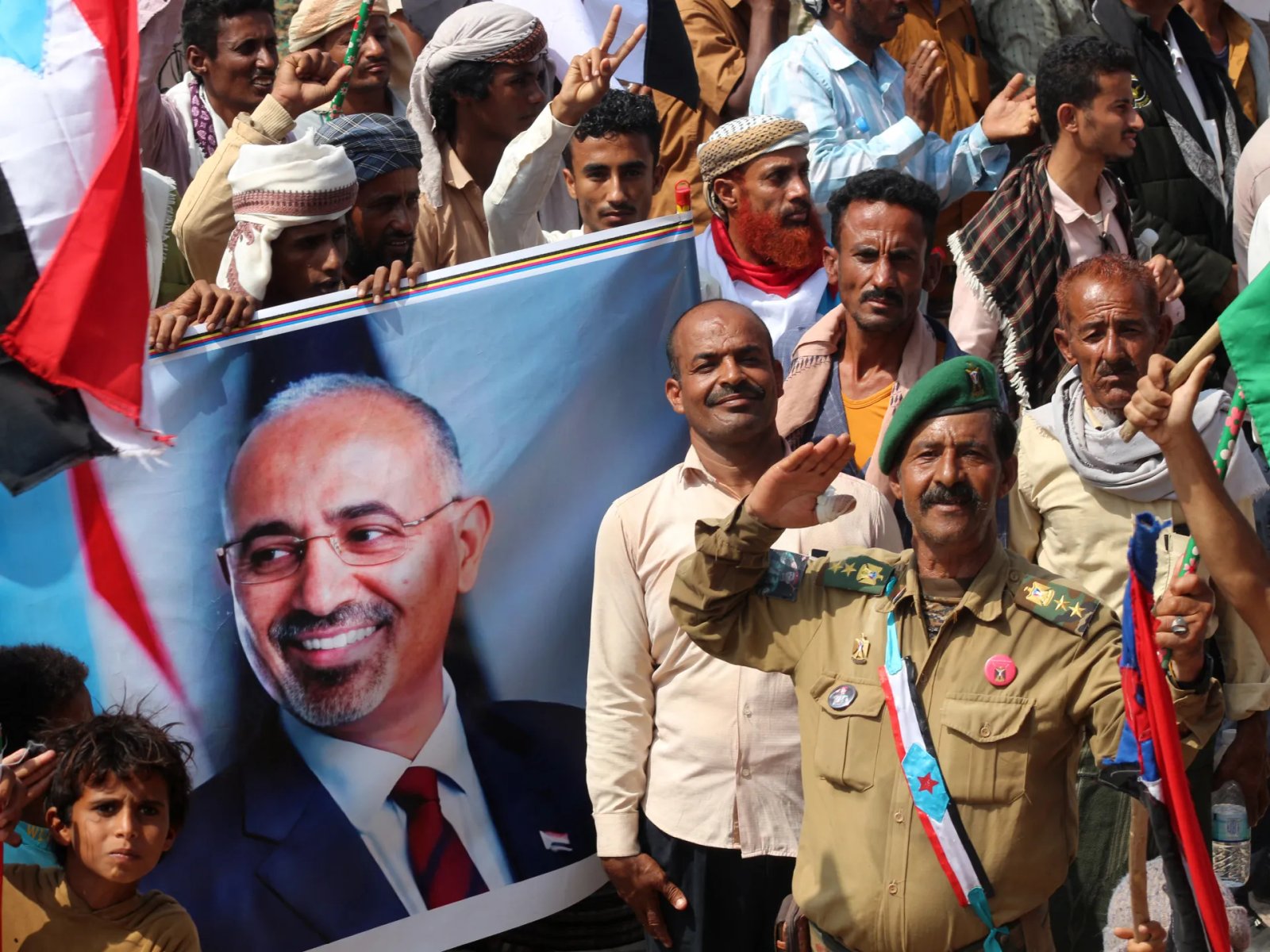
Yemen’s separatist Southern Transitional Council (STC) is trying to create facts on the ground with its recent advances in the country’s eastern governorates of Hadramout and al-Mahra.
Its military push this month highlights that Yemen’s conflict – ongoing for more than a decade – cannot be reduced to one simply between the internationally recognised government and the Houthis. Instead, an overlapping map of influence is evident on the ground with de facto authorities competing over security, resources and representation.
At the heart of these changes is the STC, backed by a regional power, which now stands as the most powerful actor in Yemen’s south and parts of its east at a time when the government’s ability to impose unified administration over the whole country is distant and the economy is suffering.
In this context comes what the Yemeni government has said is the International Monetary Fund’s (IMF’s) decision to suspend activities in the country. While the IMF has not publicly commented on the topic, President Rashad al-Alimi, the head of Yemen’s Presidential Leadership Council, warned on Sunday that the decision was a “wake-up call” and an early signal of the cost of the STC’s security and military escalation in Hadramout and al-Mahra.
Al-Alimi stressed that Yemen’s economic circumstances – the country is the poorest in the region and has suffered immensely during the war – cannot withstand any new tensions. He added that the security instability in eastern Yemen would immediately affect the distribution of salaries, fuel and services and international donor confidence.
The solution, according to al-Alimi, is for the withdrawal of forces who have arrived in Hadramout and al-Mahra from outside the two governorates, calling it a necessary step to contain tensions and restore a path of trust with the international community.
But that economic warning cannot be understood in isolation from the shift in power in eastern Yemen, where competition for influence has become a direct factor in generating tension that leaves donors wary.





 United Arab Emirates Dirham Exchange Rate