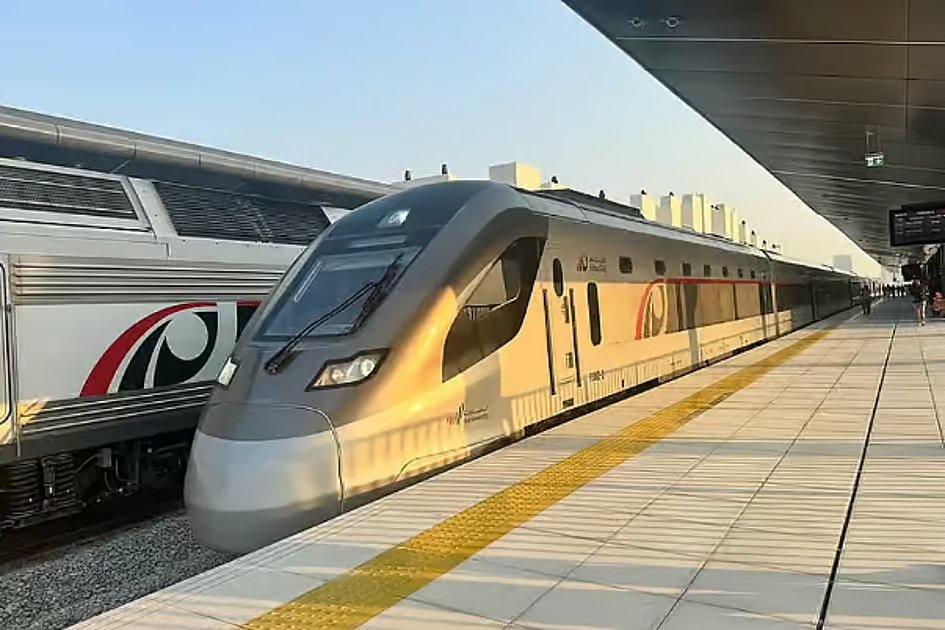
Etihad Rail began public services from Dubai’s Al Yalayis station to Abu Dhabi on September 30, with the journey taking one hour and four minutes
A Dh39 train ticket can take you from Dubai to Abu Dhabi. But how much will you spend getting to the station and reaching your destination after stepping off the train?
Etihad Rail began passenger services from Dubai’s Al Yalayis station on Wednesday, giving passengers another option to travel between the emirates. The train journey takes an hour and four minutes, but the complete trip depends on where you start and finish.
For this comparison, we use Union Metro station in Deira as the starting point and the World Trade Center end of Hamdan Street in Abu Dhabi as the destination.
Calculations are for one adult travelling one way. The rail option uses a Silver Nol card, a Comfort-class ticket and bus connections in Abu Dhabi. Driving costs use October’s petrol price, effective from October 1. Complete journey times are estimates that include connections, rather than results from a timed travel test.
Taking the train: Metro and buses complete the journey
Estimated cost: Dh59 to Dh61. Total time: Around 3 and a half to 4 hours, depending on connections.
From Union, passengers can take the Red Line towards Expo 2020 and get off at Jumeirah Golf Estates. The Silver Nol fare is Dh7.50, with the Metro journey estimated at roughly 53 minutes.
Passengers then use the pedestrian connection to Al Yalayis station. Allow time for the walk and boarding before the booked train departs.
The Dubai to Abu Dhabi Comfort fare starts at Dh39, bringing the cost to Dh46.50 before onwards travel in Abu Dhabi. The train arrives at Mohamed bin Zayed City station, where passengers need a connection to reach the city centre.
Etihad Rail has previously reported shuttle connections to Adnoc headquarters on the Corniche, ADNEC and Reem Mall at Dh10. The shuttle must be reserved through the rail booking system.
For this journey, take the shuttle to Adnoc headquarters, followed by a local bus towards the Hamdan Street area and a final walk. Allow approximately Dh2 to Dh4 for the local bus.
The estimated breakdown is:
- Dubai Metro: Dh7.50
- Etihad Rail: From Dh39
- Abu Dhabi shuttle: Dh10
- Local bus: Approximately Dh2 to Dh4
- Total: Dh58.50 to Dh60.50
Allow roughly 3 and half hours for the complete trip if connections line up. This calculation uses the previously reported shuttle fare; check its price and availability for your chosen train before booking.
Taking the intercity bus
Estimated cost: Dh37 to Dh38. Total time: Around 3 hours to 3 hours and 15 minutes.
From Union, take the Green Line to Al Ghubaiba and walk to the bus terminal. The Metro ride itself takes approximately eight minutes before waiting and walking time.
The E100 continues to Abu Dhabi Central Bus Station. RTA’s planner displays a journey of about two hours and 10 minutes for this leg, although traffic can increase travel time.
Using a Dh30 intercity fare, Dh5 for the Dubai Metro connection and approximately Dh2 to Dh3 for the final Abu Dhabi bus, the complete journey costs around Dh37 to Dh38.
Abu Dhabi’s 102 timetable includes Central Bus Station and several Hamdan Street stops. Choose the stop closest to your destination and allow for the final walk. Local fares start with a Dh2 boarding charge, plus 5 fils per kilometre.
Driving: What changes with October’s petrol prices?
Estimated cost: Dh72 to Dh85, plus parking. Total time: Around one and a half to 2 hours.
The Union metro station to WTC road distance is approximately 150 km. A car using eight litres per 100km would need about 12 litres of petrol for the journey.
Special 95 costs Dh4.28 per litre from October 1, up from Dh3.69 in September. For this example, the one-way fuel bill rises from Dh44.28 to Dh51.36, an increase of Dh7.08.
Tolls add to that amount. An illustrative route through Al Garhoud and Sheikh Zayed Road has four chargeable Salik passages. Although drivers pass both Safa gates, they pay once when crossing the pair in the same direction within an hour.
Including VAT, four charges total Dh16.80 off-peak or Dh25.20 during peak hours. Adding the Dh4 Darb charge and during charging hours, the Dh4 for an Abu Dhabi island-entry gate brings the estimated total to Dh72.16–Dh84.56 before parking.
The amount changes with the route, toll timings and the car’s fuel consumption. Standard Abu Dhabi public parking adds Dh2 an hour or Dh15 for the day.
These figures cover petrol and tolls, excluding insurance, servicing and depreciation. For two people sharing the car, the one-way trip expenses work out to approximately Dh36 to Dh42 each before parking.
What about a direct taxi?
Estimated cost: Dh389 to Dh398, before waiting and applicable Darb charges. Total time: Around 1 hour 45 minutes to 2 hours, plus pickup.
A street hailed Dubai taxi starts at Dh5 and charges Dh2.45 per kilometre. Over 150 km, that works out to Dh372.50 before tolls and waiting.
Adding the four-Salik example brings the fare to approximately Dh389–Dh398, before applicable Darb charges and waiting. An app booking may have a different starting fare.
The taxi offers a direct journey without parking or transfers. For a solo traveller, however, it costs substantially more than the other options. Heavy traffic can increase both the journey time and the metered fare.
Which should you choose?
For this journey, the intercity bus has the lowest estimated fare, at around Dh37–Dh38. Combining Metro, Etihad Rail and buses costs approximately Dh59–Dh61, with more time needed for connections.
Driving offers a shorter estimated journey and can cost less per person when shared. With October’s petrol price, a solo driver would spend approximately Dh72–Dh85 on fuel and tolls before parking.
For passengers starting in Deira and heading to central Abu Dhabi, the decision comes down to the complete trip: what it costs, how long the connections take and how much driving they want to avoid.






 United Arab Emirates Dirham Exchange Rate