
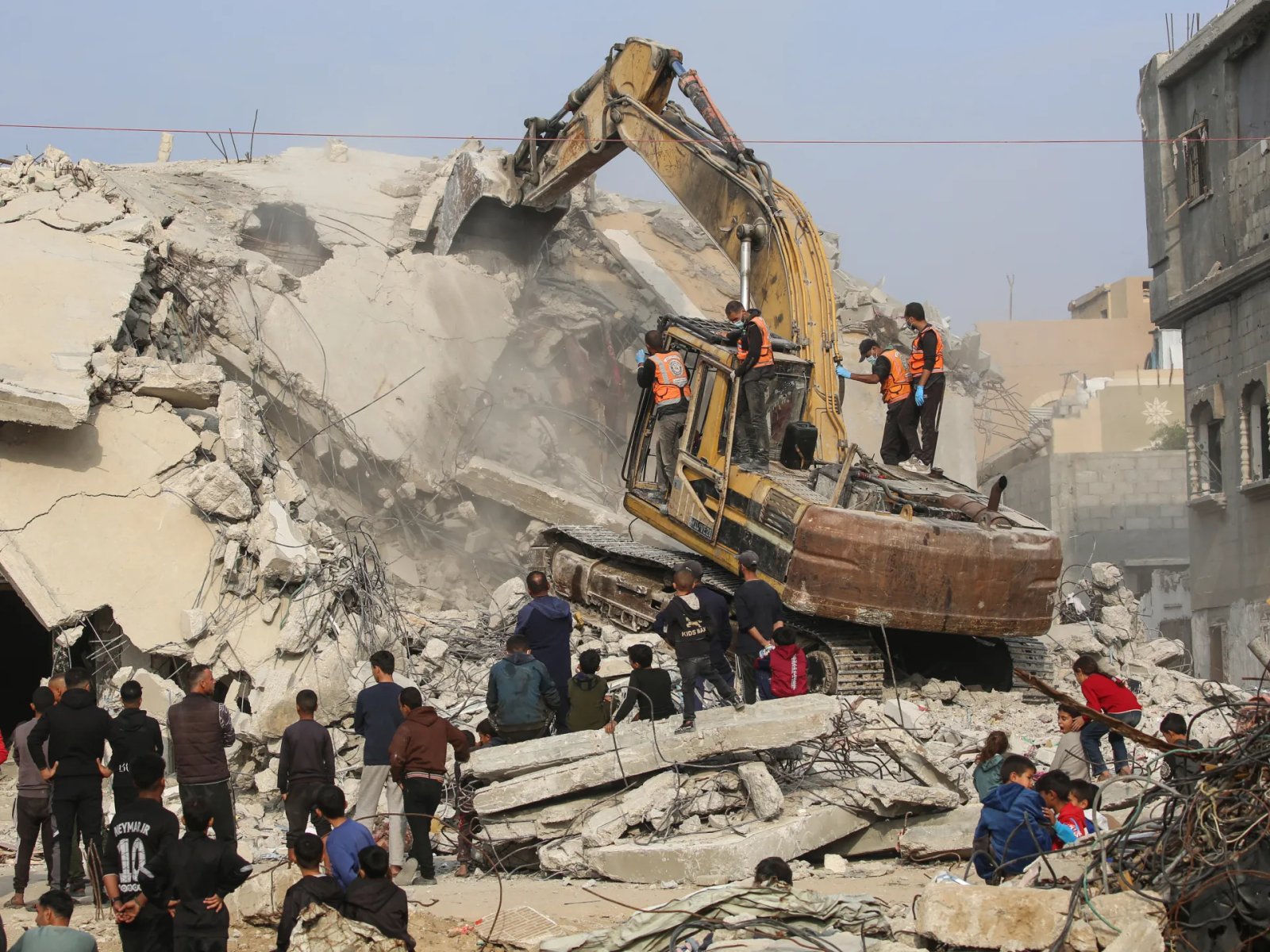
Israeli military claims yellow line is ‘new border’ as questions remain over role of stabilisation force in Gaza.
As Israel and Hamas prepare to move towards phase two of a United States-led blueprint to end Israel’s genocidal war on Gaza, disagreements loom over the as-yet undefined role of an international stabilisation force in the besieged Palestinian enclave.
Senior Hamas official Basem Naim said on Sunday that the US draft required “a lot of clarifications”. While the group was ready to discuss “freezing or storing” weapons during the ongoing truce, he said it would not accept that an international stabilisation force take charge of disarmament.
“We are welcoming a [United Nations] force to be near the borders, supervising the ceasefire agreement, reporting about violations, preventing any kind of escalations,” he said, adding that Hamas would not accept the force having “any kind of mandates” on Palestinian territory.
His comments came after Israeli Prime Minister Benjamin Netanyahu said earlier in the day that he would meet with Donald Trump to discuss entering a new phase of the US president’s plan at the end of the month. The focus of the meeting, he said, would be on ending Hamas governance in Gaza and ensuring it fulfilled its “commitment” to the plan, which calls for demilitarisation of the enclave.
“We have a second phase, no less daunting, and that is to achieve the disarmament of Hamas and the demilitarisation of Gaza,” Netanyahu said during a news conference with visiting German Chancellor Friedrich Merz.
It was not clear whether Naim’s comments on the group freezing or storing arms would satisfy Israel’s demands for full disarmament. The Hamas official said the group retained its “right to resist”, adding that laying down arms could happen as part of a process leading to a Palestinian state, with a potential long-term truce lasting five to 10 years.
The US-drafted plan for Gaza leaves the door open to Palestinian independence, but Netanyahu has long rejected this, asserting that creating a Palestinian state would reward Hamas.
US officials have said they expect “boots on the ground” early next year, but while countries like Indonesia have agreed to contribute troops, there is no roadmap for setting up the force, and its exact makeup, command structure and responsibilities have not been defined.
Netanyahu appeared to recognise the plan’s vagueness. “What will be the timeline? What are the forces that are coming in? Will we have international forces? If not, what are the alternatives? These are all topics that are being discussed,” he said on Sunday.
The Israeli prime minister said that phase two of the plan, which will be set in motion once Hamas returns the last Israeli captive, a policeman killed in the October 7 attack on southern Israel, would be “more difficult”.
Stage one of the plan has already proven challenging, with Israel continuing to bomb Gaza throughout the ceasefire, killing more than 370 Palestinians, according to health officials. Meanwhile, it has accused Hamas of dragging out captive returns.
Vague plan
The plan’s initial steps saw Israeli forces withdraw to positions behind a so-called yellow line in Gaza, though the Israeli military remains in control of 53 percent of the territory. The Israeli military said on Sunday that the line of demarcation was a “new border”.
He said a true ceasefire “cannot be completed unless there is a full withdrawal” of Israeli forces, alongside restored stability and freedom of movement for Palestinians, which has so far not transpired under phase one of the plan. He did not allude to the yellow line in his comments.
Amid growing momentum for a move to phase two of the peace plan, Israeli and Qatari officials met with US counterparts in an effort to rebuild relations after Israel’s air strike on Doha in September, Axios reported, citing unnamed sources.






 United Arab Emirates Dirham Exchange Rate