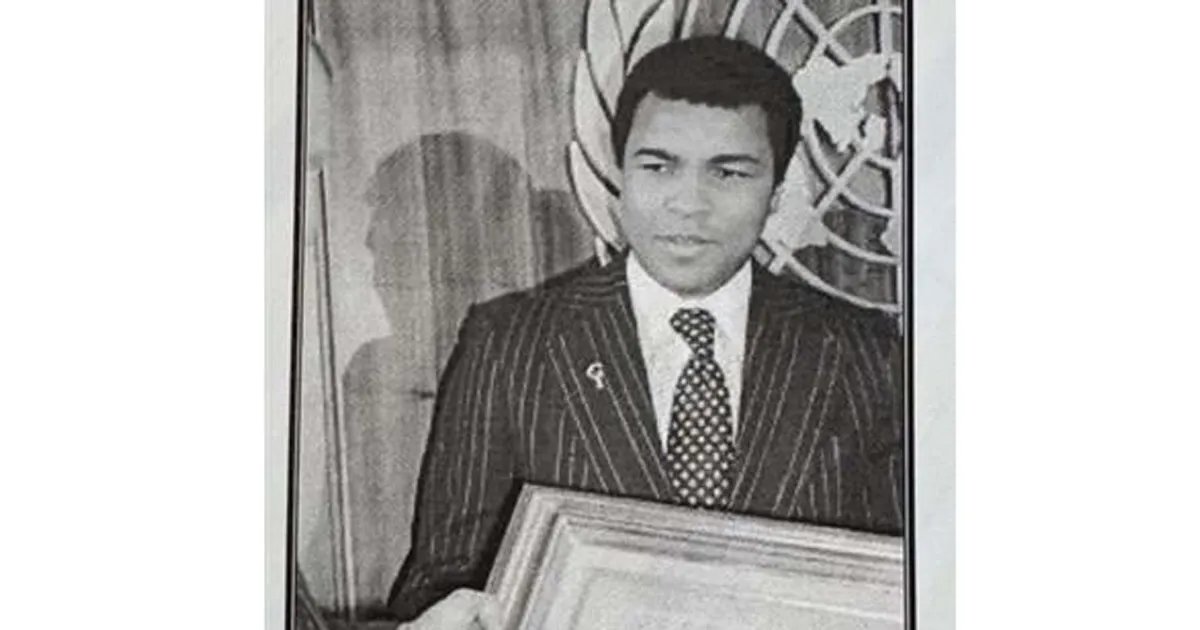
On June 3, 2016, legendary American boxer Muhammad Ali passed away at the age of 74. Ten years after the world said goodbye to him, his voice still echoes – not in the roar of a crowd or the rhythms of a boxing ring, but in a hallway just outside my office at the United Nations.
There, on the wall, hangs a watercolour painting he made himself of the UN headquarters – a gentle, almost tender rendering of the building that has come to symbolise the world’s longing for peace.
Ali painted it in 1978 and presented it personally to UN officials, calling it “a gift of peace”. It is more than an artwork – it is a bridge between his public courage and his private conviction that peace is humanity’s highest calling.
The brushstrokes are simple. The sincerity behind them is unmistakable. It is a testament from a man who understood, better than most, what it meant to fight for dignity far beyond the ring.
In a letter that accompanied the painting, Ali wrote words that still stop me in my tracks: “Service to others is the rent we pay for our room here on Earth.”
I see that line every day. And every day, it reads less like a quotation and more like a summons – a challenge to reflect on what we owe to one another in an era of fracture, inequality and conflict.
Ten years after his passing, why does his message feel even more urgent?
Because we are living in a moment when peace feels increasingly fragile – battered by wars, strained by rising hatred, tested by the unchecked expansion of new technologies and with the rights and safety of women and girls increasingly under threat.
And yet Ali’s painting speaks to something disarmingly simple: Peace remains possible, but only if we are willing to make it our personal responsibility.

 United Arab Emirates Dirham Exchange Rate