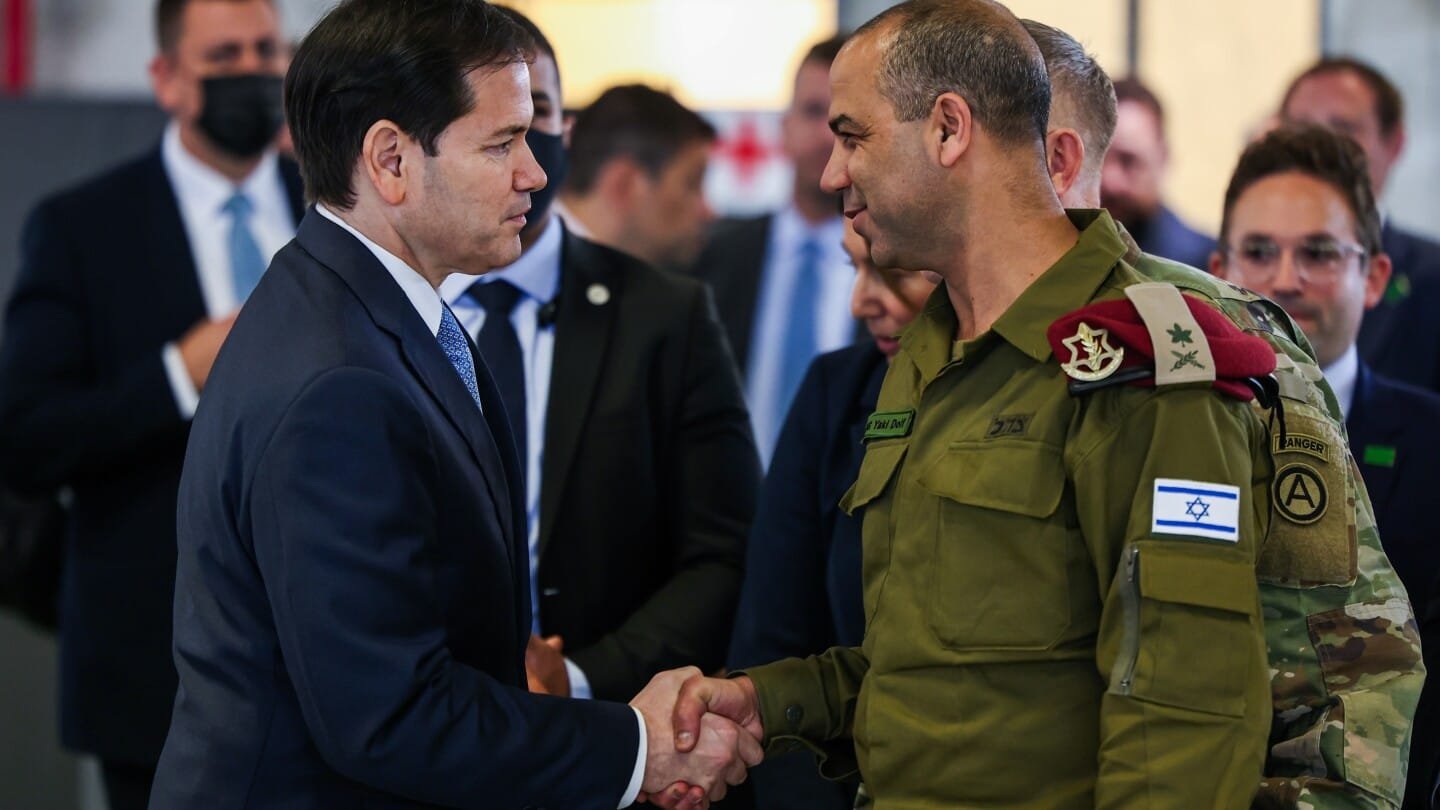
KIRYAT GAT, Israel (news agencies) — U.S. Secretary of State Marco Rubio on Friday toured a U.S.-led center in Israel overseeing the Gaza ceasefire, as the Trump administration worked to set up an international security force in the territory and shore up the tenuous truce between Israel and Hamas.
Rubio was the latest in a series of top U.S. officials to visit the center for civilian and military coordination. U.S. Vice President JD Vance was there earlier this week where he announced its opening, and U.S. envoys Steve Witkoff and Jared Kushner, the president’s son-in-law, were also in Israel.
Around 200 U.S. troops are working alongside the Israeli military and delegations from other countries at the center, planning the stabilization and reconstruction of Gaza. On Friday, an media reporter saw international personnel there with flags from Cyprus, Greece, France, Germany, Australia and Canada.
“I think we have a lot to be proud of in the first 10 days, 11 days, 12 days of implementation, where we have faced real challenges along the way,” said Rubio.
He named the U.S. ambassador to Yemen, Steven Fagin, to lead the civilian side of the coordination center in southern Israel. The center’s top military official is Adm. Brad Cooper of the U.S. Central Command.
The United States is seeking support from other allies, especially Gulf Arab nations, to create an international stabilization force to be deployed to Gaza and train a Palestinian force.
Rubio said U.S. officials were working on possible language to secure a United Nations mandate or other international authorization for the force in Gaza because several potential participants would require one before they can take part. He said many countries had expressed interest, and decisions need to be made about the rules of engagement.
He said such countries need to know what they’re signing up for, including “what is their mandate, what is their command, under what authority are they going to be operating, who’s going to be in charge of it, what is their job?” He also said Israel needs to be comfortable with the countries that are participating.
Rubio met with Israeli Prime Minister Benjamin Netanyahu on Thursday. Israeli media has referred to the parade of American officials visiting their country to make sure the ceasefire stays on track as “Bibi-sitting.” The term, using Netanyahu’s nickname of Bibi, refers to an old campaign ad when Netanyahu positioned himself as the “Bibi-sitter” whom voters could trust with their kids.
In Gaza City, Palestinians who have been trying to rebuild their lives have returned home to rubble.
Families are scrounging to find shelter, patching together material to sleep on with no blankets or kitchen utensils.
“I couldn’t find any place other than here. I’m sitting in front of my house, where else can I go? In front of the rubble, every day I look at my home and feel sorrow for it, but what can I do?” said Kamal Al-Yazji as he lighted pieces of sponge to cook coffee in Gaza City.
His three-story house, once home to 13 people, has been destroyed, forcing his family to live in a makeshift tent. He said they’re suffering from mosquitos and wild dogs and they can barely afford food because their banknotes are so worn that shopkeepers won’t accept them.
As Umm Muhammad al-Araishi walked in the Gaza City neighborhood where she lived before the war, she was looking for a familiar landmark, the Rantisi hospital. But the hospital and the buildings around it were heavily damaged by Israel — which had declared the area a “combat zone” — to the point where little was recognizable.
“I couldn’t find the place, I didn’t recognize where my house is, I didn’t recognize the whole neighborhood,” she said.







 United Arab Emirates Dirham Exchange Rate