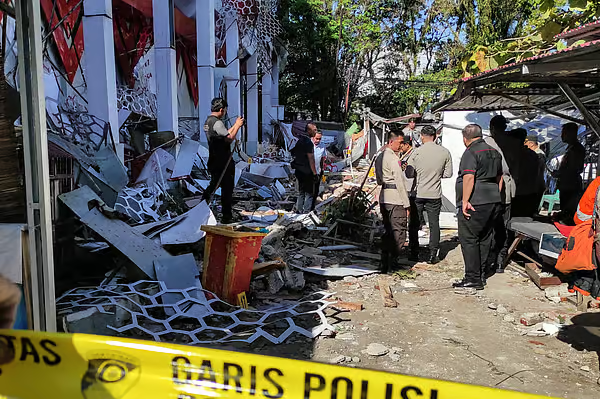
Tremor in Molucca Sea triggers waves up to 2.5 feet; dozens of aftershocks rattle region as residents describe panic and building collapses
JAKARTA – A powerful 7.4-magnitude earthquake struck off the coast of eastern Indonesia on Thursday, killing at least one person, damaging buildings, and sending panicked residents fleeing into the streets. A tsunami warning issued after the tremor has since been lifted.
The early-morning quake in the Molucca Sea, located between the Sulawesi and Maluku island groups, generated waves up to 75 centimetres (2.5 feet) in some areas, according to Indonesia’s BMKG geological agency. The Hawaii-based Pacific Tsunami Warning Center (PTWC) initially warned of hazardous tsunami waves within 1,000 kilometres (621 miles) of the epicentre, but lifted the warning just over two hours later, stating the threat “has now passed”.
Victim Buried Under Rubble
One person was killed when a building collapsed in Manado, the capital of North Sulawesi province, search and rescue official George Leo Mercy Randang told AFP. Another person was injured.
The victim was “buried under the rubble,” Randang said, adding that authorities were investigating reports of additional injuries.
‘I Just Tried to Save My Family’
Street food vendor Siti Rohayati, 58, described the moment the quake hit during the breakfast rush in Manado, a city of approximately 450,000 people.
“I didn’t know what to do. I was just trying to save my family,” she told AFP. “All that mattered was getting my children away safely. I pushed all three of them and told them: ‘Run!'”
An AFP journalist in Manado, located about 300 kilometres west of the epicentre by sea, said the shaking woke him and others. “I immediately woke up and left my house. People were immediately scrambling outside. There is a school and the pupils rushed outside,” he said. He noted the shaking persisted for “quite long” but added that he did not witness “significant damage”.
Widespread Panic, Aftershocks
Budi Nurgianto, a 42-year-old resident of Ternate in North Maluku province, said he was inside his house when the tremor struck. “The quake was felt strongly. I heard it first from the walls of the house that shook,” he said. “When I went outside, there were many people outside. They were panicked. The quake was felt quite long, more than a minute. I even saw some people leaving their house without having finished their shower.”
Dozens of aftershocks rippled through the area following the main quake, according to Teuku Faisal Fathani, head of Indonesia’s geological agency. The US Geological Survey (USGS) recorded one aftershock of magnitude 5.9.
The USGS said the initial tremor struck at a shallow depth of 35 kilometres (22 miles), which often amplifies shaking and damage.
Regional Alerts
The PTWC initially warned that tsunami waves of up to one metre were possible for parts of Indonesia, with smaller waves possible for the Philippines, Malaysia, Japan, Taiwan, Guam, and Palau. The Japan Meteorological Agency said it expected “slight changes” in sea level along the Pacific coast but did not issue any warnings. Earthquake centres in the Philippines and Malaysia also did not issue tsunami alerts.
‘Ring of Fire’ Seismic Activity
Indonesia and neighbouring countries frequently experience earthquakes due to their location on the Pacific “Ring of Fire” – an arc of intense seismic activity where tectonic plates collide, stretching from Japan through Southeast Asia and across the Pacific basin.
In 2004, a catastrophic magnitude-9.1 earthquake struck Indonesia’s westernmost Aceh province, triggering a massive tsunami that killed more than 170,000 people in Indonesia alone.







 United Arab Emirates Dirham Exchange Rate