
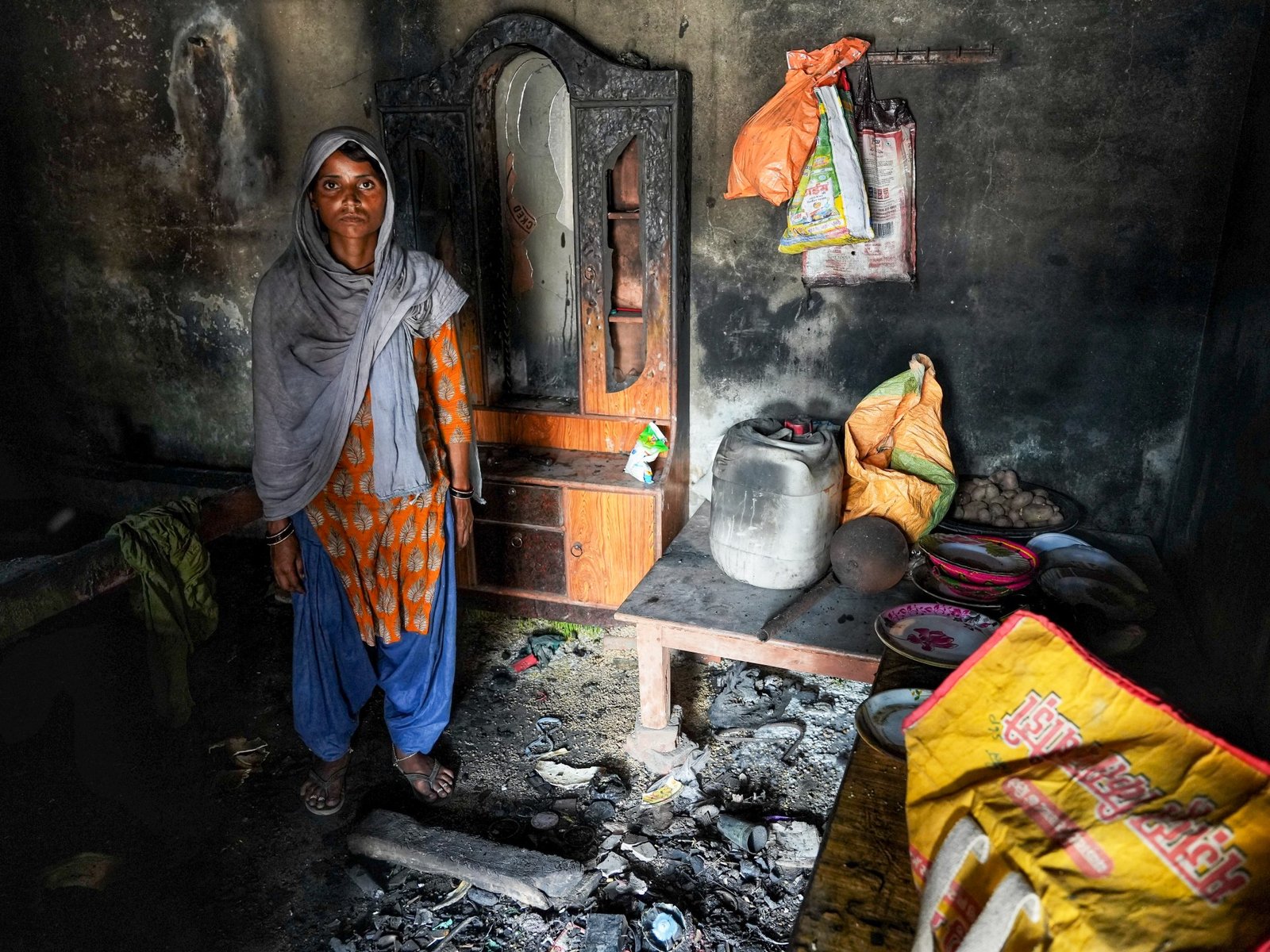
Bahraich, India – At about 10:30am on October 14, Mohammad Kaleem received a frantic call from a friend, urging him to flee with his family.
A day earlier, a 22-year-old Hindu man, Ram Gopal Mishra, was allegedly shot dead by a Muslim man while a Hindu religious procession was passing through the Muslim-dominated neighbourhood of Maharajganj, 5km (3.1 miles) from Kaleem’s home in Kapurpur village in Bahraich district of the northern Indian state of Uttar Pradesh.
Religious processions – of all faiths – have for centuries been a part of India’s diverse social fabric, where different communities have lived cheek by jowl. But in recent years, as Hindu far-right groups have grown increasingly assertive under the rule of Prime Minister Narendra Modi’s Hindu majoritarian Bharatiya Janata Party (BJP), many processions have taken on a darker hue. Hindu groups now often march through Muslim localities while playing Islamophobic songs on loudspeakers and raising hate-filled slogans.
“This has been happening at every Hindu procession that has passed the village in the last three to four years,” Dawood Ahmed, 32, who owns a shop in Maharajganj, told media.
This year, tensions exploded. A widely shared video on social media purportedly shows Mishra climbing the terrace of a house in Maharajganj, shaking the iron railing on the roof until it broke, and then tearing down a green flag on top of the house and replacing it with a saffron flag. Green flags with Islamic motifs are common on Muslim homes while saffron is a colour often used by right-wing Hindu groups.
Seconds after Mishra hoisted the saffron flag, a bullet pierced his chest and his body fell down on the terrace. According to villagers and Mishra’s relatives, he died of his injuries on the spot — although Mishra’s wife insisted he could have been saved if the police had taken him to hospital faster than they did. The autopsy cited shock and haemorrhage caused by a gunshot wound as the causes of death.
Police charged the house’s owner, Abdul Hameed, 62, who has a jewellery business, and his two sons, Mohammad Sarfaraz, 32 and Mohammad Taleeb, 28, with Mishra’s killing and arrested them On October 17. The next day, a local court ordered five accused, including Hameed and his sons, to remain in judicial custody for 14 days. Sarfaraz is accused of having fired the fatal shot from a rifle that is registered in Hameed’s name.
Meanwhile, Mishra’s killing sparked communal tensions in Bahraich, a district bordering Nepal. On October 14, thousands of outraged Hindus gathered in Maharajganj for Mishra’s last rites. Once done with the rituals, the crowd turned violent and went on a rampage, targeting Muslim properties within a radius of about 10km (6.2 miles), ransacking and burning them down.
Kaleem, 32, was helping others in his village flee and hide in rice fields about the time a mob arrived. Stuck and with nowhere to go, Kaleem hid his wife, Nagma Begum, 28, their four-year-old son, six-month-old daughter and himself in jute bags under the two cots in their bedroom.







 United Arab Emirates Dirham Exchange Rate