
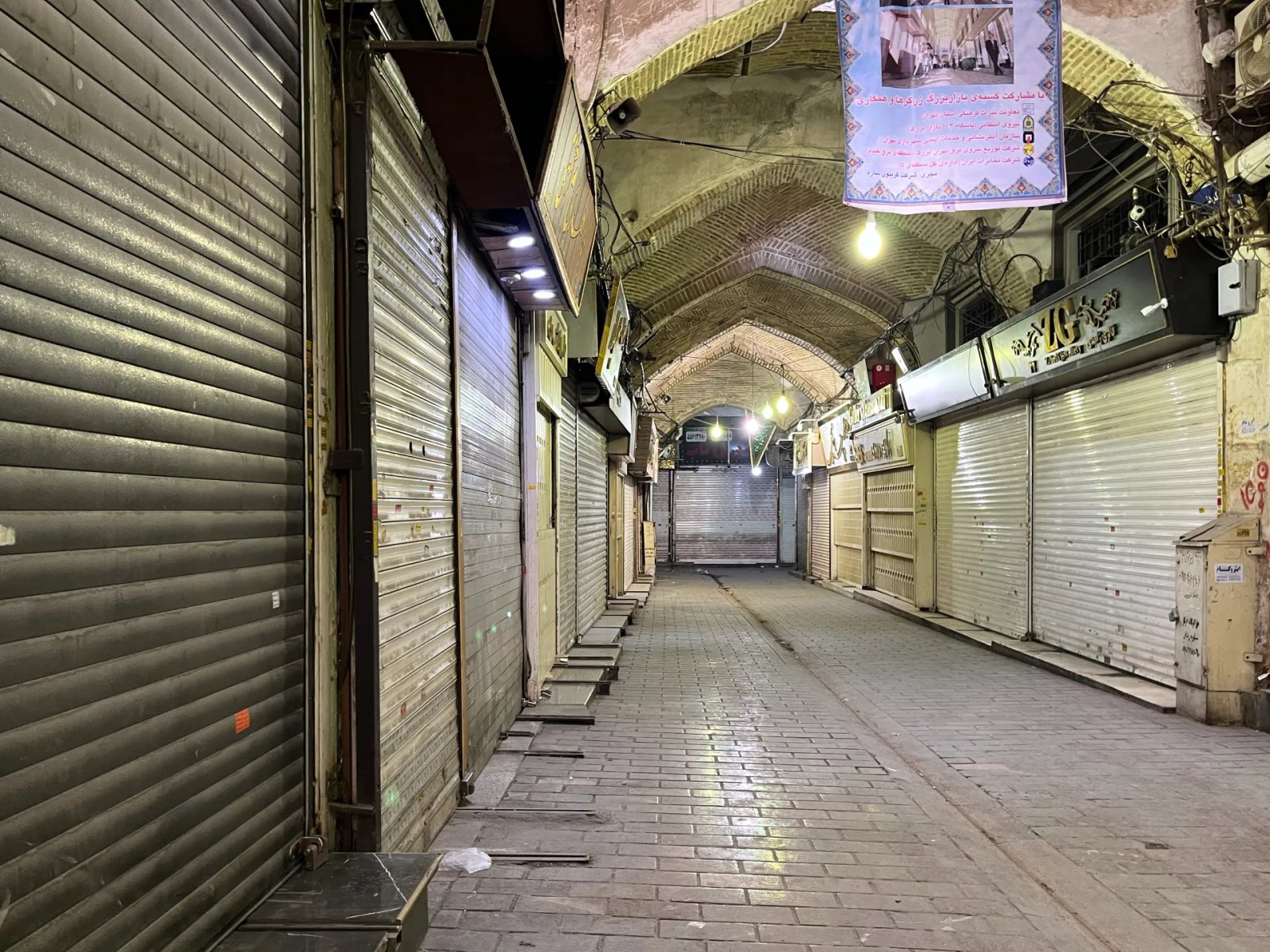
In his first public remarks since mass protests broke out in Iran, Supreme Leader Ali Khamenei sought to draw a sharp line between what he deemed the “legitimate” grievances of the bazaar and outright rebellion across the country. “We talk to protesters; the officials must talk to them, but there is no benefit to talking to rioters. Rioters must be put in their place,” he said.
The distinction was deliberate. Khamenei went on to praise the bazaar and its merchants as “among the most loyal sectors” of the Islamic Republic, insisting that the enemies of the state could not exploit the bazaar as a vehicle to confront the system itself.
Yet his words failed to mask the reality on the ground. Protests continue in the Tehran Bazaar, prompting authorities to deploy tear gas against demonstrators chanting antistate slogans, including ones targeting the supreme leader. The state’s attempt to symbolically separate the bazaar from the broader unrest failed in practice, exposing the limits of its narrative control.
Khamenei’s invocation of the revolutionary legacy of the bazaar is rooted in historical facts. The bazaar played a decisive role in the 1979 revolution that overthrew Mohammad Reza Shah Pahlavi and remained aligned with conservative political networks in the following decades. But this historical loyalty no longer guarantees political quiescence.
Over the past 20 years, the economic standing of the bazaar has been steadily eroded by state favouritism towards the economic machinery of the Islamic Revolutionary Guard Corps (IRGC) and large religious-revolutionary foundations (bonyads), sanctions management, and chronic inflation. As a result, what was once a staunch base of the regime has become another casualty of systemic dysfunction.
In the aftermath of the 1979 revolution, powerful bazaar merchants, often operating through the bazaar-affiliated Islamic Coalition Party, were folded directly into the architecture of the new state. They gained influence over key institutions and ministries, including the Ministry of Trade and Commerce, the Ministry of Labour, and the Guardian Council.
This political access translated into material advantage. Despite the enthusiasm of powerful figures in the new revolutionary state for total nationalisation, including control over foreign trade, the bazaar maintained a dominant role in Iran’s commercial trade throughout the 1980s. Bazaar merchants secured import licences, ran the largest trading firms under the supervision of the Ministry of Commerce, and benefitted from preferential access to the official exchange rate, which was far below market value. These imported goods were sold to Iranians at market prices, generating substantial profits.
When the Islamic Republic turned towards economic liberalisation in the 1990s, political forces tied to the bazaar, often described as the “traditional right”, backed President Akbar Hashemi Rafsanjani in sidelining Islamist leftists from both the cabinet and the Majles. Although some of Rafsanjani’s market reforms later collided with bazaar interests and gave rise to the so-called “new right”, most notably the Servants of Reconstruction Party, the bazaar and its allies retained substantial influence within the state.
The reformist agenda of Rafsanjani’s successor, President Mohammad Khatami, also did not fundamentally threaten the economic position or political clout of the bazaar. Key institutions—the Guardian Council, the Assembly of Experts, and the judiciary—remained firmly under the control of the “traditional right”, insulating the bazaar from meaningful challenge.

 United Arab Emirates Dirham Exchange Rate