
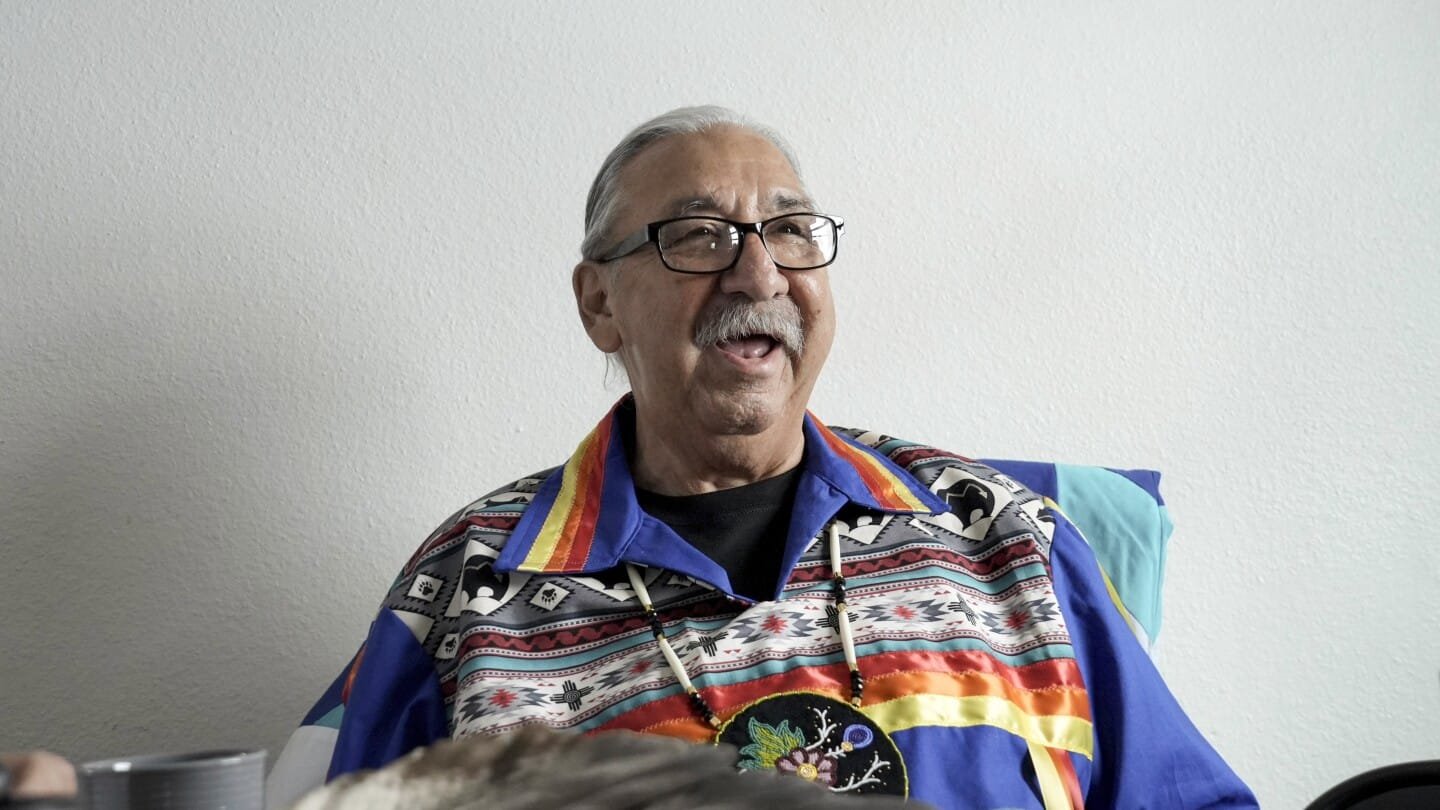
More than 50 years after a shootout on the Pine Ridge Indian Reservation landed him in federal prison, Leonard Peltier remains defiant.
He maintains his innocence in the deaths of two FBI agents in 1975 and sees his newfound freedom — the result of a commutation from former President Joe Biden — as the beginning of a new phase of his activism.
“I’m going to spend the rest of my life fighting for our people, because we ain’t finished yet. We’re still in danger,” Peltier, now 80, said in an exclusive interview with the media at his new home on the Turtle Mountain Reservation, his tribal homeland in North Dakota, near the Canadian border.
There among the rolling, often snow-covered hills, he will serve out the rest of his sentence on house arrest.
Born into an era of violent hostility between the American government and Indigenous peoples, the former American Indian Movement member has now stepped into another politically volatile moment in the country. He said he understands well the threats the rise of the far right, as well as the federal government, pose to tribal nations and Indigenous peoples. He believes that, like previous administrations, President Donald Trump will come for mineral and oil on tribal lands.
“You don’t have to get violent, you don’t have to do nothing like that. Just get out there and stand up,” he told news agencies this week, in his first sit-down conversation with a journalist in over 30 years. “We got to resist.”
Peltier was part of a movement in the late 1960s and 1970s that fought for Native American rights and tribal self-determination, sometimes occupying federal and tribal property.
The movement grabbed headlines in 1973 when it took over the village of Wounded Knee on Pine Ridge, leading to a 71-day standoff with federal agents. They also protested at Alcatraz and the Bureau of Indian Affairs headquarters. For many members of the American Indian Movement, or AIM, their activism was part of legacy of resistance stretching back to the country’s founding.
The day of the shootout came amid heightened tensions on the Pine Ridge reservation, where residents felt the FBI’s heavy presence was a threat to the people’s autonomy. Peltier and other AIM members got into a confrontation with agents Jack Coler and Ron Williams when the agents drove onto a rural property where the AIM members were staying. Both agents were shot and killed, along with Joseph Stuntz, another AIM member.
The FBI says Peltier shot the agents at close range. In a letter sent to Biden last year opposing his release, former FBI director Christopher Wray called Peltier a “remorseless killer”.
His guilt is clear to many, including North Dakota Governor Kelly Armstrong.
“More than 20 federal judges upheld his conviction, and he was denied parole as recently as last July,” Armstrong said in a statement to the media. “There was no legal justification for his release. He should still be in prison.”
Peltier was not pardoned; Biden said he was commuting Peltier’s sentence because of his age, his declining health, and the long period he had already been in prison.
Peltier has acknowledged he was at the shootout, but says he acted in self-defense and wasn’t the one whose bullets killed the agents. He believes the FBI and prosecutors were looking for someone to take the blame, after his two co-defendants were exonerated for self-defense.
“They wanted revenge, and they didn’t know who was responsible,” Peltier told the news agencies from the kitchen table of his new home. “And they said ‘Put the full weight of the American government on Leonard Peltier, we need a conviction.’ And when they say that you don’t have no rights,” he said.
Amnesty International and scores of political leaders around the world called Peltier a political prisoner of the U.S., questioning the fairness of his trial and conviction. James Reynolds, the former U.S. Attorney who oversaw Peltier’s conviction, urged clemency in a letter to Biden in 2021, acknowledging that prosecutors couldn’t prove Peltier fired the fatal shots and calling his imprisonment “unjust”.
His grandson, Cyrus Peltier, remembers visiting him every weekend at Leavenworth, a federal prison in Kansas. He didn’t always understand why his grandfather wouldn’t just tell the parole board he was sorry for the crimes, and hopefully win his freedom.
“And he would say ‘Well, that’s just not what I’m fighting for, grandson,’” Cyrus Peltier, now 39, recalled from his home in North Dakota this week. ”‘I’m sorry for what happened to those agents, but I’m not going to sit here and admit to something I didn’t do. And if I have to die in here for that, I’m going to.’”
In prison, Peltier’s fame only grew, as he amassed the support of prominent political leaders around the globe and celebrities in the U.S. and became a symbol of the injustices against Native Americans.
He said it was all their letters of support and acts of protest for his release that kept him going.





 United Arab Emirates Dirham Exchange Rate