• About
  • Advertise
  • Privacy & Policy
  • Contact Us
Sunday, May 17, 2026
Dubai News TV
  • UAE
    • Abu Dhabi
    • Dubai
    • Ajman
  • REGION
    • Middle East
    • GCC
    • MENA
      • Syria
    • Asia
      • Afghanistan
      • Bangladesh
      • India
      • Iran
      • Israel
      • Pakistan
      • Sri Lanka
    • Africa
    • Europe
  • REAL ESTATE
  • Opinion
    • EDITOR’S CHOICE
    • The Big Read
    • Viewpoint
    • EXCLUSIVE
  • World
  • Business
    • Local Business
    • Markets
  • TECH
  • HEALTH
  • Horoscope
  • PR
  • Sports
No Result
View All Result
  • UAE
    • Abu Dhabi
    • Dubai
    • Ajman
  • REGION
    • Middle East
    • GCC
    • MENA
      • Syria
    • Asia
      • Afghanistan
      • Bangladesh
      • India
      • Iran
      • Israel
      • Pakistan
      • Sri Lanka
    • Africa
    • Europe
  • REAL ESTATE
  • Opinion
    • EDITOR’S CHOICE
    • The Big Read
    • Viewpoint
    • EXCLUSIVE
  • World
  • Business
    • Local Business
    • Markets
  • TECH
  • HEALTH
  • Horoscope
  • PR
  • Sports
No Result
View All Result
Dubai News
No Result
View All Result
  • Top News
  • UAE
  • Dubai
  • World
  • Business
  • GOLD/FOREX
  • REGION
  • REAL ESTATE
  • FEATURED
  • EDITOR’S CHOICE
  • ENVIRONMENT
  • Road To Financial Freedom
  • Health
  • Sports

The strike that changed the geometry of war

by News Desk
6 hours ago
in Middle East, REGION, Top News
The strike that changed the geometry of war
Share on FacebookShare on TwitterShare on Whatsapp

Israel’s attacks on Doha in September and Tehran in February demonstrated a new capability that may make warfare more unpredictable.

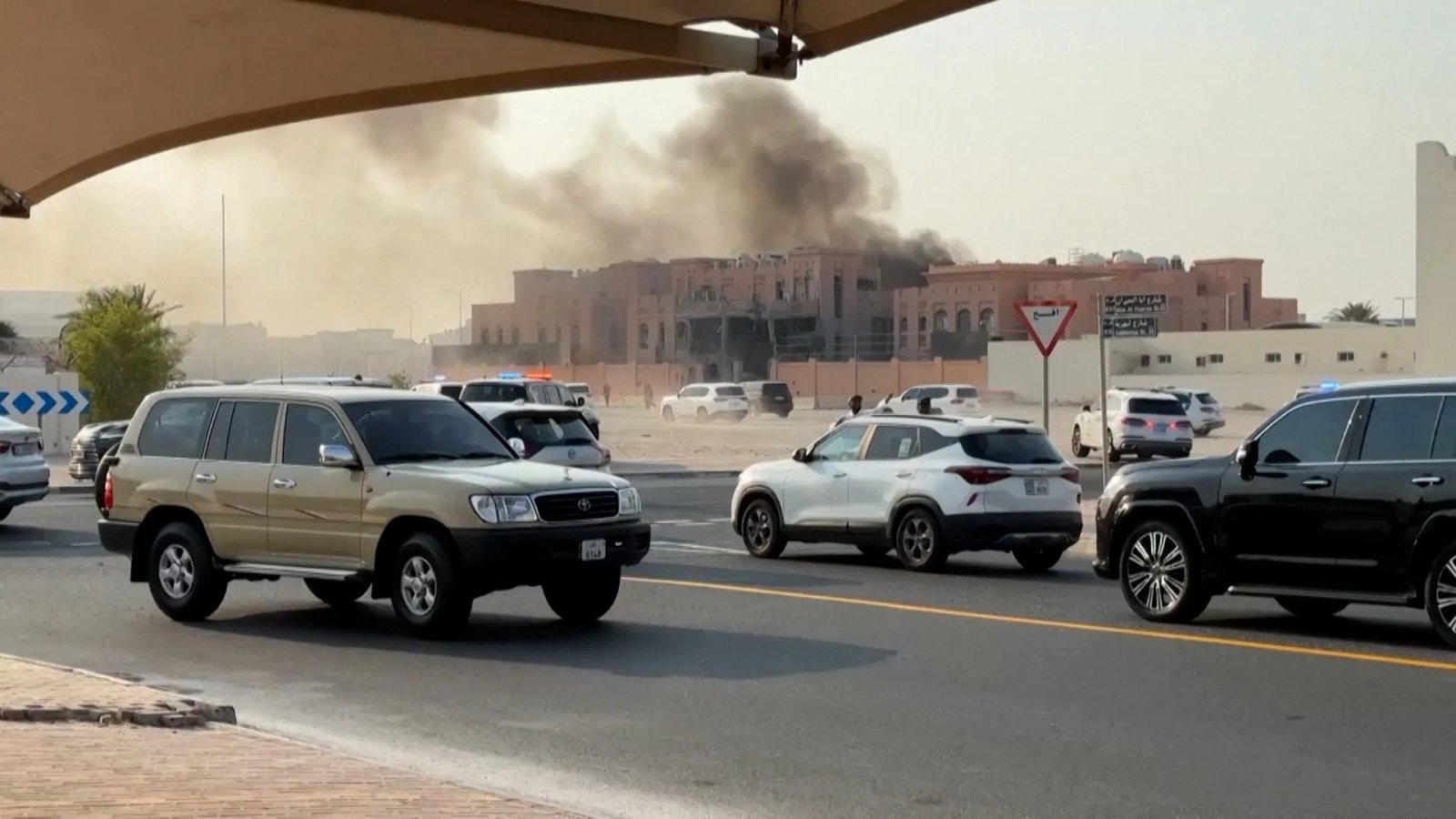
On September 9, 2025, Israel struck Qatar. There was no battlefield, no front line. Instead, the target was a sovereign state hosting negotiations that Israel itself was involved in. When the missile hit Doha, it set a dangerous precedent.

That same strike architecture reappeared on February 28, at the start of the US-Israel war on Iran, when the compound of Supreme Leader Ayatollah Ali Khamenei was targeted in Tehran.

In both cases, Israeli aircraft remained outside the target state’s airspace and released a missile that completed the strike independently. That single operational choice removes the defining constraint of air warfare: penetration.

The Doha strike was a strategic error because it exposed this capability unnecessarily. The target — a meeting of Hamas leadership convened to review a ceasefire proposal from the Trump administration — was political, not strategic. Israel later had to apologise for the strike, but the fact remained that its new capability had been exposed.

Israel did not employ a conventional bombing model. Instead, it executed an integrated operational sequence built upon a mature fused C7ISR (Command, Control, Communications, Computers, Combat Systems, Cyber, Cognition, Intelligence, Surveillance, and Reconnaissance) architecture — a system integrating cyber and cognitive warfare with intelligence and command networks to accelerate decision-making and maintain superiority in the modern battlespace. This construct enabled precise timing, persistent situational awareness, and overwhelming operational accuracy. The aircraft itself was not the decisive element. The system was.

An Israeli F-15I aircraft flew over international waters in the Red Sea and aligned roughly with the latitude of the Saudi port of Yanbu, but remained outside Saudi sovereign airspace. This was deliberate. Any direct route across the Arabian Peninsula would have required overflight of Saudi territory and would have carried a high probability of engagement by Saudi Arabia’s sophisticated, multilayered air-defence architecture.

From that corridor, the F-15I released an air-launched ballistic missile (ALBM) from the Israeli Sparrow family, likely the Silver Sparrow variant. This is a missile which is carried by an aircraft, but once released, it behaves like a heavier medium-range ballistic missile (MRBM). After separation, a rocket booster ignites, accelerating the missile into a suborbital trajectory that carries it beyond the dense layers of the atmosphere into near space.

Midcourse, the missile follows a ballistic arc entirely outside the conventional air defence envelope. The strike concludes in the terminal phase. The missile re-enters the atmosphere steeply at hypersonic speed, committing to a near-vertical descent onto the target.

Even advanced systems, such as THAAD, Patriot, and emerging higher-tier interceptors, cannot overcome this constraint. They can extend detection and improve engagement probability. They cannot create the time or engagement depth that the physics of the trajectory eliminates.

This is the limitation. It is not merely technological; it is defined by velocity, friction and geometry.

The Tehran strike followed the same logic, likely using the Blue Sparrow, a variant from the same missile family, and an alternative launch corridor. The F-15I is assessed to have operated over eastern Syrian or western Iraqi airspace, creating a northern vector into Iran. This reduced distance and simplified the trajectory, but the underlying architecture remained unchanged.

Different geography, same system.

The technology behind these strikes introduces a second layer of consequence. The launch system has been integrated onto the F-15I — an older variant — through deep structural and software modification. That level of integration implies access to source code, mission system architecture, and the aircraft’s onboard mission data library.

The Sparrow lineage is also significant: it was originally developed as a ballistic target missile for missile defence testing and has been adapted into a standoff strike weapon, marking a clear doctrinal shift from testing architecture to operational use.

That is critical. Source code governs the launching platform’s logic. The onboard library governs how it processes sensor inputs, identifies targets, integrates weapons, and executes strike logic. Together, they define operational sovereignty.

Why was this level of access permitted in one case and not in others?

This is not a minor technical issue. It goes to the core of arms transfers, source-code control, onboard library autonomy, and the real independence of advanced air forces.

But the deeper consequence lies beyond procurement.

By demonstrating this capability — first against Qatar, then against Iran — Israel has shown that this model works. Once demonstrated, it becomes replicable.

The components already exist across multiple states: aircraft capable of carrying heavy payloads, ballistic missile technology, guidance systems, and integration pathways. The US, Russia, China, France, Pakistan and a few others possess the industrial base to develop comparable architectures.

This pushes the concept towards the practical edge of space weaponisation — not orbital, but suborbital. The system operates beyond traditional atmospheric engagement zones before re-entry. Once normalised, that boundary will erode.

And once eroded, there is no return.

The result is a structural shift in vulnerability. The same physics applies to all actors. No defence system can exempt itself from it.

Israel extended its reach. It also demonstrated the conditions under which others can do the same. It is now just a matter of time before others can replicate this system.

The implications for world leaders are profound. As these capabilities proliferate, warfare will become more unpredictable, more dangerous, and more vulnerable to miscalculation, compressing decision-making timelines and forcing leaders to make consequential choices in minutes rather than days. They can become instruments not only of deterrence and war, but also of coercion, regional competition, and the settling of strategic rivalries.

Geography, distance and strategic depth are losing their traditional value as buffers of warning and protection. The sense of safety is increasingly disappearing.


Share21Tweet13Send

Related Posts

The strike that changed the geometry of war
International

The strike that changed the geometry of war

May 17, 2026
Amid the fertiliser crisis, Africa has a chemical-free option: Agroecology
International

Amid the fertiliser crisis, Africa has a chemical-free option: Agroecology

May 16, 2026
How David Ben-Gurion got the Palestinians wrong in 1948
International

How David Ben-Gurion got the Palestinians wrong in 1948

May 15, 2026
In the UK, Muslim votes are treated as a problem to be managed
International

In the UK, Muslim votes are treated as a problem to be managed

May 14, 2026
Trump needs Xi much more than Xi needs Trump
International

Trump needs Xi much more than Xi needs Trump

May 13, 2026
The crisis is Sudan is much worse than what is acknowledged
Middle East

The crisis is Sudan is much worse than what is acknowledged

May 12, 2026
Load More
  • The crisis is Sudan is much worse than what is acknowledged

    The crisis is Sudan is much worse than what is acknowledged

    54 shares
    Share 22 Tweet 14
  • The crisis is Sudan is much worse than what is acknowledged

    53 shares
    Share 21 Tweet 13
  • Your daily horoscope: May 12, 2026

    53 shares
    Share 21 Tweet 13
  • In the UK, Muslim votes are treated as a problem to be managed

    53 shares
    Share 21 Tweet 13
  • The Global Sumud Flotilla is sailing on, here is why

    53 shares
    Share 21 Tweet 13
  • The war on Iran will likely end in American retreat

    53 shares
    Share 21 Tweet 13
  • UAE President makes over 100 calls, drives diplomatic efforts amid Iranian attacks

    54 shares
    Share 22 Tweet 14
  • Lessons from the war: A call for strategic reckoning in West Asia

    53 shares
    Share 21 Tweet 13
  • The Global Sumud Flotilla is sailing on, here is why

    53 shares
    Share 21 Tweet 13
  • Your daily horoscope: May 14, 2026

    53 shares
    Share 21 Tweet 13
United Arab Emirates Dirham Exchange Rate


About Dubai News TV

Dubai News is an English language news and current affairs digital TV channel established to provide round-the-clock news, information, and knowledge about local, regional, and international events. It covers a wide range of topics, including politics, business, technology, culture, and sports, ensuring viewers stay informed and engaged with the latest developments. The channel aims to deliver accurate, unbiased reporting and insightful analysis, catering to a diverse audience with a global perspective.

Categories

  • Abu Dhabi (43)
  • Afghanistan (32)
  • Africa (29)
  • Ajman (5)
  • Artificial Intelligence (5)
  • Asia (82)
  • Bangladesh (87)
  • Business and Economy (773)
  • Cricket (11)
  • Donald Trump (6)
  • Dubai (162)
  • EDITOR'S CHOICE (10)
  • Education (29)
  • Entertainment (1,943)
  • ENVIRONMENT (13)
  • Europe (91)
  • EXCLUSIVE (4)
  • FEATURED (41)
  • Featured Stories (40)
  • Global Business (2,259)
  • Gold & Forex (1)
  • Healthcare (9)
  • heath (10)
  • Horoscope (697)
  • Hospitality (1)
  • India (177)
  • International (8,666)
  • Iran (27)
  • Israel (18)
  • Israel-Palestine conflict (76)
  • Life Style (1)
  • Lifestyle (1,372)
    • Health (8)
  • Local Business (1,636)
  • Markets (14)
  • MENA (818)
  • Military & Defense (8)
  • News (11,524)
    • Business (2,169)
    • Politics (13)
    • World (8,736)
      • Foods (1)
      • Games (2)
      • Travel (6)
  • Opinion (26)
  • Outreach Initiatives (1)
  • Pakistan (287)
  • Personal Finance (7)
  • Philippine (11)
  • Philippines (7)
  • PR (157)
  • REAL ESTATE (170)
  • REGION (4,266)
    • GCC (210)
    • Middle East (3,334)
  • Road To Financial Freedom (7)
  • Russia (28)
  • Russia-Ukraine war (73)
  • Saudi Arabia (16)
  • Sharjah (12)
  • South Asia (91)
  • Sports (1,232)
  • Sri Lanka (45)
  • Startup (7)
  • Syria (7)
  • Tech (500)
  • Technology (491)
  • The Big Read (6)
  • Top News (24,868)
  • turkey (9)
  • TV Shows (7)
  • UAE (6,867)
  • Uncategorized (10)
  • Video Posts (11)
  • Viewpoint (8)

Latest News

The strike that changed the geometry of war
Middle East

The strike that changed the geometry of war

by News Desk
May 17, 2026
0

Israel’s attacks on Doha in September and Tehran in February demonstrated a new capability that may make warfare more unpredictable.On...

Read moreDetails
The strike that changed the geometry of war

The strike that changed the geometry of war

May 17, 2026
Your daily horoscope: May 16, 2026

Your daily horoscope: May 16, 2026

May 16, 2026
  • About
  • Advertise
  • Privacy & Policy
  • Contact Us

© 2024 Dubai News TV - Powerd by Global Biz International.

No Result
View All Result
  • Top News
  • UAE
  • Dubai
  • World
  • Business
  • GOLD/FOREX
  • REGION
    • South Asia
      • Pakistan
      • India
    • GCC
    • Middle East
  • REAL ESTATE
  • FEATURED
    • Featured Stories
  • EDITOR’S CHOICE
    • The Big Read
    • Viewpoint
  • ENVIRONMENT
  • Road To Financial Freedom
  • Health
  • Sports

© 2024 Dubai News TV - Powerd by Global Biz International.

This website uses cookies. By continuing to use this website you are giving consent to cookies being used. Visit our Privacy and Cookie Policy.