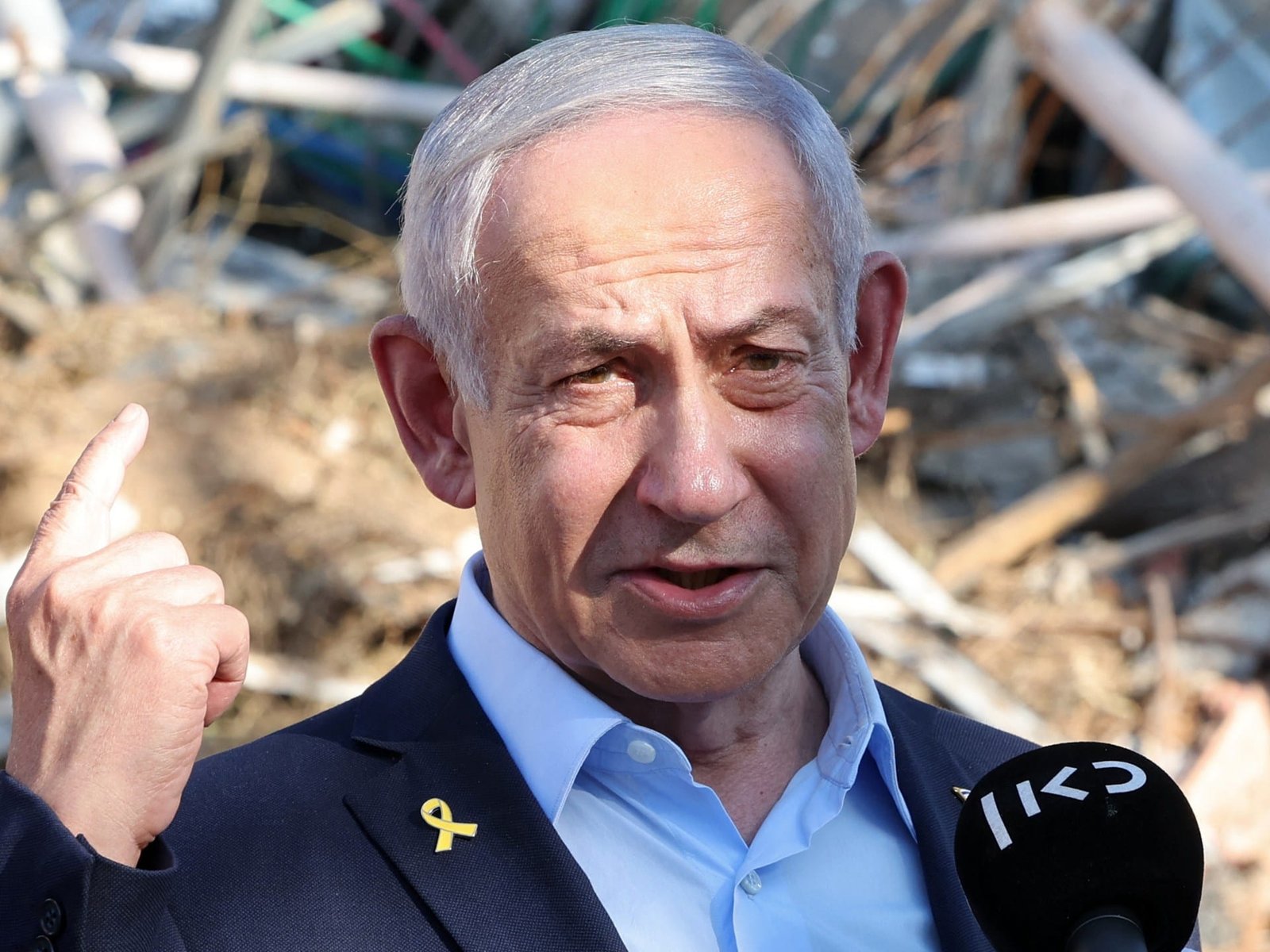
Credited with having confronted Israel’s greatest foe, Netanyahu finds a ceasefire is doing little to solve his other challenges.
As the Israel-Iran ceasefire staggered into effect on Tuesday, all of the combatants launched a plausible argument for victory.
In the United States, President Donald Trump claimed that both his diplomatic and military interventions had largely been responsible for halting the fighting, while the leaders of Iran and Israel each claimed to have secured a decisive win in a regional contest that dates back decades.
In Israel, however, the emerging narrative is that the end result of the conflict with Iran has solidified the position of Prime Minister Benjamin Netanyahu.
Just two weeks ago, Netanyahu was in real trouble. On the night before he ordered the unilateral strike on regional nemesis Iran, his governing coalition was only able to survive thanks to a last-minute deal with dissenting members. Public and political opinion had also appeared to have turned against his war on Gaza, and internationally, Israel’s allies were beginning to protest the blockade of the Palestinian enclave.
Now, he can argue that he has severely weakened Israel’s most dangerous regional enemy, Iran, and he claims that its nuclear programme has been destroyed and sent “down the drain”.
Buoyed by rising poll numbers and the sense of having successfully confronted Iran, Netanyahu may, according to reports in Israel, seek to take advantage politically and call snap elections.
“My oldest daughter is 22 now, and has never known anything else,” Goldberg said. “Netanyahu is now getting the credit for having confronted that.”
In a video statement released earlier today, Israel’s far-right Finance Minister Bezalel Smotrich framed the conflict in characteristically apocalyptic terms, telling his social media followers, “The State of Israel has defeated in the last twelve days the empire of evil that threatened the entire world and sought the destruction of Israel.”
That argument is supported by much of the Israeli public – which has largely supported right-wing and far-right parties in recent years.
“Netanyahu is stronger than ever,” Mitchell Barak, an Israeli pollster and former political aide to several senior Israeli political figures, including Netanyahu, told media. “No one’s going to bring him down, no one’s going to challenge him, not his opponents, not his detractors, nobody.”
“He showed that Israel can go it alone. He held off, before American help, then continued alone. Bennett, Lapid can’t challenge that,” Barak continued, referring to two former Israeli prime ministers, the right-wing Naftali Bennett and the centrist Yair Lapid, who are both opponents of Netanyahu.
Gaza deal?
However, how long the Israeli prime minister’s perceived victory will last is uncertain. The Iranian government and its Islamic Republic form of governance remain in place, even as Netanyahu has repeatedly called for its overthrow. Netanyahu insinuated that regime change was a possible result of the conflict between Israel and Iran, and Trump used the term in a social media post on Sunday, before clarifying on Monday that he was opposed to regime change because it could lead to “chaos”.
And despite Israeli claims, it is too early to have a definitive answer on the condition of Iran’s ballistic missile and nuclear weapons programmes. The former, despite Israel’s effective air defence systems, led to the deaths of at least 28 Israelis during the conflict, while Iran is likely to shroud its nuclear programme in secrecy going forward. Early intelligence assessments are reported to have determined that Iran’s nuclear timeline has been delayed, but not destroyed.
However, how long Netanyahu may be able to survive on spin alone remains far from certain, Mekelberg added. “Every Houdini eventually comes across a lock they can’t pick,” he said.
Netanyahu’s actions since the start of Israel’s war on Gaza in October 2023 have arguably made his country’s position weaker in the long term. Israel’s international isolation has increased, with revulsion worldwide at the Israeli military’s actions in Gaza, where it has killed more than 56,000 Palestinians. Netanyahu himself is wanted by the International Criminal Court for war crimes, and South Africa has led a number of other countries in taking Israel to the International Court of Justice, accusing it of carrying out genocide in Gaza.
The images of those killed, including thousands of children, and the total destruction of Gaza, have spread on social media in particular, turning many in the West against Israel. This has become particularly noticeable in the US, where even on the right – traditionally a bastion of support for Israel – support for the country has become controversial.
And while Trump has shown himself to be a pro-Israeli president, the perception among many in his “America First” movement that Israel dragged the US into a war against Iran has led to anger and heavy criticism of Israel among many of Trump’s most prominent supporters.
Trump himself publicly reprimanded Israel after the latter planned to launch a large attack on Iran after the ceasefire began on Tuesday. Eventually, Israel conducted only a small and symbolic attack, following what it said was a ceasefire violation by Iran – one that Trump was clear did not warrant a response.
Some indication of the fury that has greeted Netanyahu’s decision to abuse the terms of Trump’s ceasefire was provided by Trump’s former chief strategist and ally Steve Bannon. Speaking on his War Room podcast on Tuesday, Bannon called Netanyahu a “bald-faced liar” and Israel a “protectorate”.
Appearing to address Netanyahu directly, Bannon continued, “You have the gall – particularly after what [Trump] did for you and the grief he’s taken over here – you have the gall … When he said, ‘This is what I’ve done, and I need you to be a partner, I need you to stand down first’, you lied to him. That’s why he’s furious”.
While Israel can put the conflict with Iran behind it – for now – the war on Gaza continues, with no sign of Israel finding an alternative force to Hamas to rule the enclave, and no deal to secure the release of the Israeli captives still held in the Palestinian territory.
That may put a wrench in any plans for Netanyahu to secure another term as prime minister in the short term.
“I’m not so sure about snap elections,” Aida Touma-Suleiman, a member of parliament representing the Hadash-Ta’al Party, said.


 United Arab Emirates Dirham Exchange Rate