
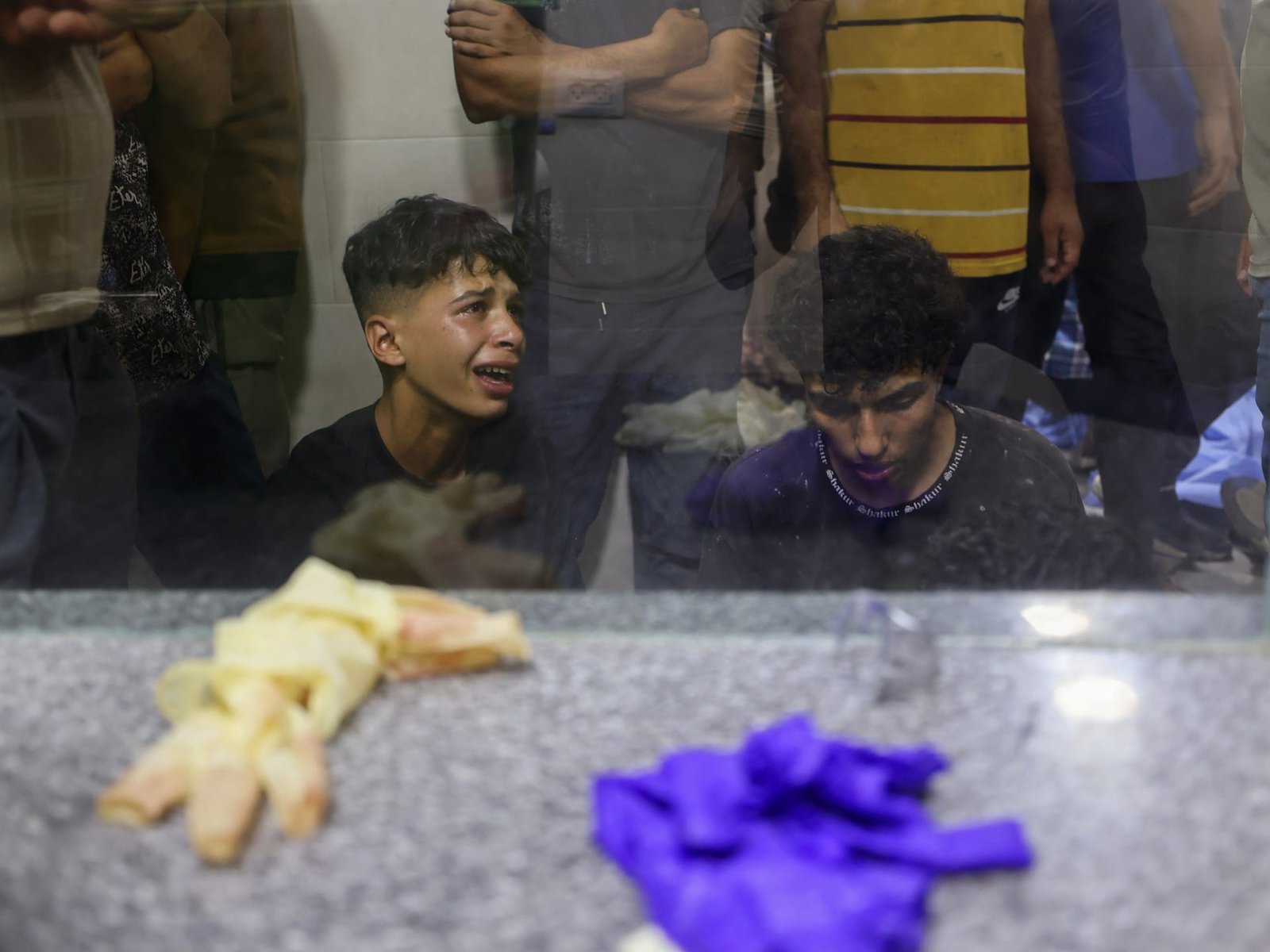
Palestinians still flock to Gaza Humanitarian Foundation aid sites, even after hundreds are killed by Israeli forces.
Khan Younis, Gaza – At the sight of her son Ahmed’s bullet-riddled body laid out in the courtyard of Nasser Hospital in southern Gaza, Asmahan Shaat collapsed on the ground, overcome by grief. Her screams echoed through the air, her voice choked by shock and sorrow.
She kissed the 23-year-old’s face, hands and feet as she cried. Her six other children and relatives tried to hold her back, but she pushed them away.
“Leave me with him. Leave me with him,” she cried. “Ahmed will speak again. He told me, ‘Mom, I am not going to die. I’ll bring you something from the aid centre in Rafah.’”
Ahmed had left the displaced family’s shelter in al-Mawasi before dawn on Thursday to collect food. He never returned.
His cousin, Mazen Shaat, was with him. Mazen said Ahmed was shot in the abdomen when Israeli forces opened fire on a crowd near the United States-backed Gaza Humanitarian Foundation (GHF) aid distribution centre in Rafah. Others were also killed and wounded.
In just one month, 600 Palestinians have been killed and more than 4,200 wounded by Israeli fire near GHF aid distribution sites, according to Gaza’s Government Media Office, and the number of deaths at these centres climbs on a near-daily basis. What were meant to be lifelines – facilitated by the US while bypassing United Nations agencies – have instead become fatal chokepoints.
Human rights organisations and UN officials have criticised the GHF model as militarised, dangerous and unlawful. A report published by the Israeli newspaper Haaretz on Friday quoted Israeli army soldiers saying they had been ordered to shoot into unarmed crowds, even when no threat was present.
Asmahan’s grief turned to fury: “Is it reasonable that my son should die because he went to bring us food? Where is the world that calls itself free? How long will this torture go on?”
Inside the morgue at Nasser Hospital, not far from where Ahmed lay, 25-year-old Shireen threw herself on the body of her husband, Khalil al-Khatib, 29. She was barely able to stand as she sobbed.
“Khalil, get up. Your son Ubaida is waiting for you,” she cried. “I told him this morning, ‘Daddy will come back soon.’ We don’t want food – we want you.”
Khalil had also left from al-Mawasi in search of aid. His father-in-law, Youssef al-Rumailat, said Khalil was careful to avoid Israeli tanks and never expected to be targeted.
“He was a gentle man,” Youssef said. “He feared for his safety in a place where everything has become deadly, so he hadn’t been able to provide anything for his children. His son Ubaida, who just turned five, would ask for bread or rice. And he’d cry because he couldn’t provide that or milk for his youngest, born just days into the war.”
‘We want you, not food’
“They use our desperation,” Youssef said bitterly. “Nothing is more painful for a man than not being able to provide for his family. These places are now death traps. This is not aid. This is annihilation.”
Youssef said the family, like many others, has lost all trust in the new humanitarian mechanism. “We don’t want this blood-soaked aid. Let us go back to the UN system. At least we weren’t being killed trying to eat.”
Mustafa Nabil Abu Eid, 31, displaced from Rafah to al-Mawasi, was returning from the Rafah distribution point with his friend Abdullah Abu Ghali, 39. They were carrying a few bags of pasta, rice and lentils in their backpacks.
Mustafa described the trip as a “death journey”.
“We walk about 2km [1.2 miles] just to reach the edge of the zone,” he said. “Then we wait – hours sometimes – until tanks move back. When they do, we run across open ground. You don’t know if you’ll get food or be killed.”
He said he’s often asked why people still go.
“There’s no choice. If we stay in the tents, we die from hunger, disease, bombing. If we go, we might die, but we might also bring something back for our kids.”
Mustafa has five children. His eldest, Saba, is 10. His youngest – twins Hoor and Noor – just turned three.
“They cry from hunger. I can’t bear it. We search for life through death.”
Aid agencies have warned that famine is already present in parts of Gaza. The Integrated Food Security Phase Classification (IPC) reported in June that the entire population is facing acute food shortages with more than one million people at risk of starvation. Children are dying from malnutrition and dehydration.
With UNRWA’s operations severely restricted and the GHF offering limited, inconsistent and dangerous access to food, desperate civilians have little choice but to risk their lives for basic sustenance.
Since the American-Israeli aid initiative began on May 27, 39 people remain unaccounted for, presumed missing or killed near the aid zones, according to Gaza’s government. Some have likely been buried in unmarked graves or remain trapped under rubble or in inaccessible terrain.
The systematic attacks on civilians at aid sites may amount to war crimes, according to international legal experts and human rights watchdogs. Under international humanitarian law, parties to a conflict must ensure the protection of civilians and the unhindered delivery of humanitarian aid.





 United Arab Emirates Dirham Exchange Rate


