
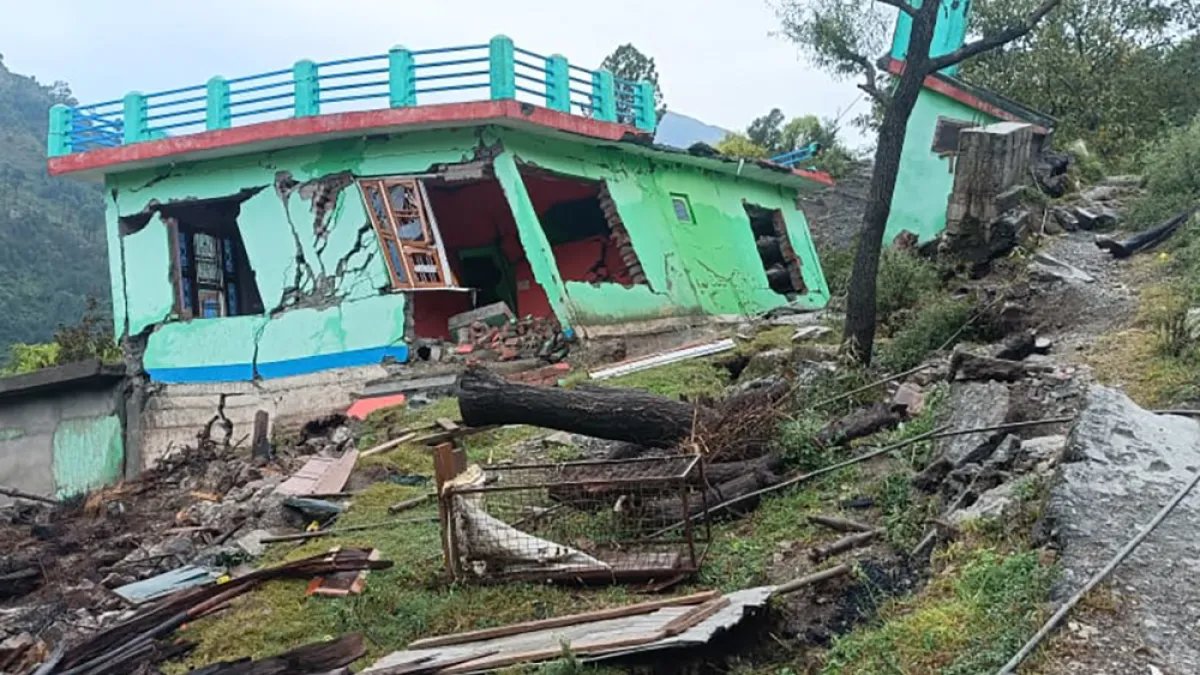
Indian-administered Kashmir – On the night of September 2, Shabir Ahmad’s home was swallowed by mud and swept into the river after relentless rains triggered a landslide in Sarh village in Indian-administered Kashmir’s Reasi district.
“I had been building my house brick by brick since 2016. It was my life’s work. Only less than a year ago, I had finished constructing the second floor, and now there is nothing,” the 36-year-old father of three children told media.
Ahmad’s was among nearly 20 houses in Sarh lost to the Chenab River that night, including one belonging to his brother, as dozens of families helplessly watched their farmlands, shops and other properties worth millions of rupees vanish without a trace.
“We don’t even have one inch of land left to stand on,” said Ahmad from a government school in Sarh, where his family and other villagers were sheltering after the deluge.
The tragedy at Sarh was among the latest of increasingly frequent climate disasters across India that destroy lives and livelihoods, and displace millions of people to an uncertain future.
According to the Geneva-based Internal Displacement Monitoring Centre (IDMC), climate-related disasters forced more than 32 million people from their homes in India between 2015 and 2024, with 5.4 million displacements recorded in 2024 alone – the highest in 12 years. This makes India one of the three nations most affected by internal displacements due to climate change in that period, with China and the Philippines being the top two.
Moreover, in the first six months of 2025, more than 160,000 people were displaced across India due to natural disasters, as the country received above-average rainfall, triggering huge floods and landslides, and submerging hundreds of villages and cities.
To help millions of people like Ahmad who are vulnerable to the climate crisis, India’s Ministry for Environment, Forest and Climate Change launched a National Adaptation Fund on Climate Change (NAFCC) in 2015. Its goal was to finance projects that help communities cope with floods, droughts, landslides, and other climate-related stresses across India.
Managed by the National Bank for Agriculture and Rural Development (NABARD), the flagship scheme supported interventions in agriculture, water management, forestry, coastal protection, and climate-resilient infrastructure. Between 2015 and 2021, it financed more than two dozen projects, benefitting thousands of vulnerable households.







 United Arab Emirates Dirham Exchange Rate