
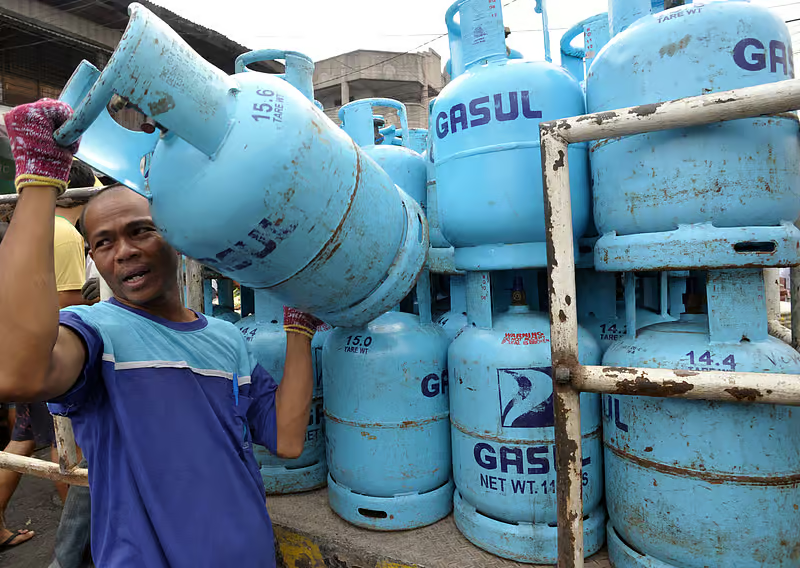
Industry insiders warn of a P385 to P440 spike per 11-kg cylinder starting April 1, as soaring shipping costs and contract prices squeeze household budgets amid the US-Israel-Iran war.
MANILA — Filipino households face yet another financial blow as liquefied petroleum gas (LPG) prices are set to surge dramatically next week, with industry insiders warning of a P385 to P440 increase per 11-kilogram cylinder starting April 1.
The sharp hike, driven by escalating shipping costs from the Gulf region and higher international contract prices, comes as the US-Israel-Iran war continues to disrupt global energy markets with no signs of de-escalation.
What’s Driving the Price Spike?
Arnel Ty, founder of the LPG Marketers Association, told reporters that two key factors are behind the impending increase:
- Shipping Costs: Soaring freight rates from the Middle East will add approximately P30 per kilogram.
- Contract Prices: Higher international LPG contract prices will contribute an additional P5 per kilogram.
Ty predicted that a standard 11-kilogram LPG cylinder could soon cost around P1,500 (approximately Dh93), reflecting the cumulative impact of the conflict on the country’s primary cooking fuel.
Since the outbreak of the war on February 28, prices of other petroleum products—including diesel, petrol, and kerosene—have already risen nearly threefold.
Government: ‘Close Monitoring’ Is All It Can Offer
Under the Philippines’ oil industry deregulation law, the government has limited levers to control prices. Energy Secretary Sharon Garin acknowledged this constraint during a Senate hearing earlier this week, admitting that the government can only offer “close monitoring” of LPG supply.
“One of our major problems now is LPG,” Garin told legislators. “So, now, we’re starting to go around the restaurants and beverages (stores) because, maybe, we can lower the consumption for a bit until we get the supply coming in.”
Supply Crunch: Only 24 Days of Inventory Left
The looming price hike is compounded by shrinking inventories. According to the Department of Energy’s (DOE) March 20 inventory report, LPG has the lowest supply among all fuel products in the Philippines, with stocks sufficient for only 24 days.
The situation is particularly concerning given the country’s heavy reliance on LPG for daily cooking. Approximately 40% to 50% of Filipino households—around 8 million families—use LPG as their primary cooking fuel. The residential and commercial sectors together account for over 89% of total national LPG consumption.
Import Dependence Exposes Vulnerability
While the Philippines does have some domestic LPG production, it remains heavily dependent on imports to meet its requirements. The country sources LPG from Gulf nations such as the UAE, Saudi Arabia, and Qatar—all of which are directly impacted by the ongoing conflict in the Middle East.
The closure of the Strait of Hormuz and broader supply chain disruptions have made shipping routes increasingly precarious, driving up both freight costs and the price of the commodity itself.
What Lies Ahead?
With the April 1 price adjustment looming, Filipino consumers—already grappling with inflation and rising fuel costs—now face the prospect of significantly higher expenses for a household essential.
Industry observers note that unless regional hostilities ease or alternative supply routes are secured, further price increases may be inevitable. For now, the government’s ability to intervene remains constrained by deregulation laws, leaving consumers to bear the brunt of global market volatility.







 United Arab Emirates Dirham Exchange Rate