
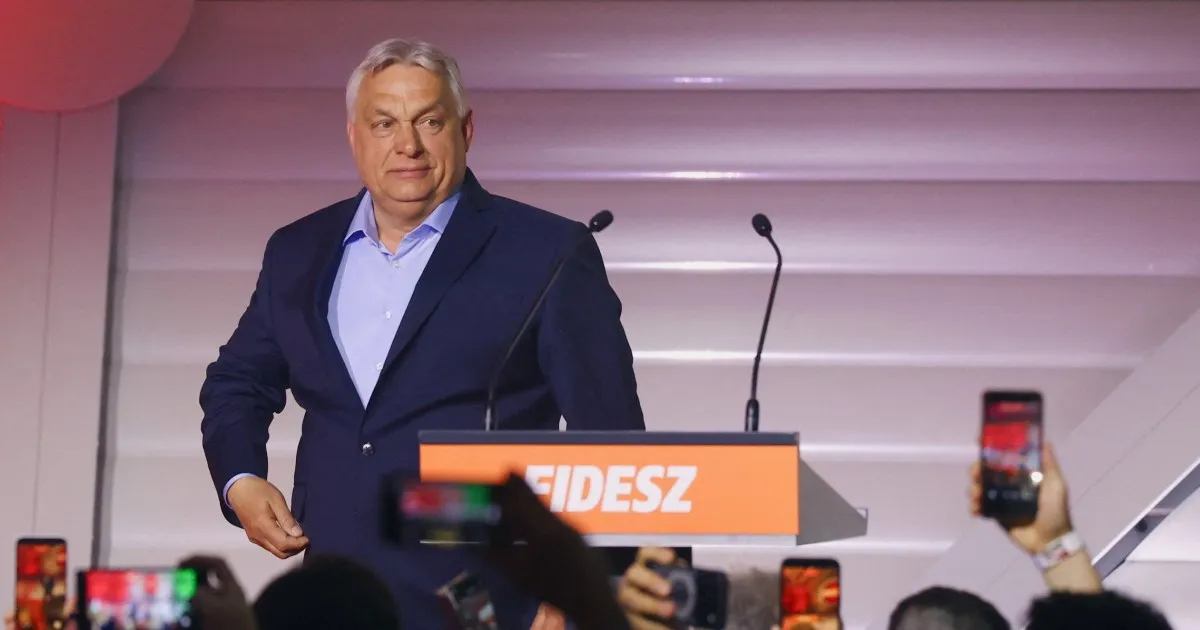
On Sunday, Hungarian Prime Minister Viktor Orban suffered a major defeat in the legislative election after 16 years in power. For all the talk of him being an authoritarian or even a dictator, he quickly conceded defeat in a tearful speech to his supporters.
Amid all the doom and gloom in the European Union, Orban’s political demise is certainly a cause for celebration. But it is a Pyrrhic victory for the EU’s current leaders and the centrist, liberal-democratic cause they claim they represent. Orban’s political career might be dead-ended, but Orbanism is very much alive and kicking.
The EU is going through its worst geopolitical crisis in its history. Its inept, visionless leadership thinks in outdated 20th-century cliches and strives to outperform its openly illiberal rivals in jingoistic tough talk, especially when it comes to Russia. But on top of failing to deliver on their promises to suffocate Russian President Vladimir Putin’s regime economically and defeat it militarily in Ukraine, they are now facing the real prospect of a political breakup with the United States and a large-scale economic crisis caused by US President Donald Trump’s decision to go to war with Iran.
The victory of an ostensibly pro-Brussels Hungarian party, led by Peter Magyar, has provided a rare opportunity for EU Commission President Ursula von der Leyen to rejoice. She wrote on X that Hungary “has chosen Europe” and that it “returns to its European path”.
Framing everything in messianic, civilisational terms that smack of Western supremacism is the current EU commission’s signature style, even as it defies history.
Hungary didn’t “choose Europe” – it is a country in the heart of Europe which has helped shape European politics for centuries. Under Orban, it did so disproportionally to its size and economic weight.
It was Orban’s first government that brought Hungary into NATO in 1999 and that successfully conducted negotiations on Hungary’s accession to the EU. Orban’s subsequent political slide towards illiberalism, which eventually led him to embrace Trump, Putin, and Israeli Prime Minister Benjamin Netanyahu, might seem radical, but it aligns with the continent’s overall shift to the hardcore right. Von der Leyen’s presidency of the European Commission reflects the same shift, even more grotesquely than Orban when it comes to militarism.
It is important to note here that the winner of Sunday’s elections, Peter Magyar, head of the Tisza party, is Orban’s former ally who displays much the same set of political values (or the lack thereof), especially when it comes to the issue of immigration and even of geopolitics.
Like the majority of Hungarians, Magyar is a Ukraine-sceptic who doesn’t want his country to aid Kyiv financially or militarily, even though his government is expected to unblock the EU’s 90-billion-euro ($105bn) loan to Ukraine, crucial for sustaining the war with Russia in the next couple of years.





 United Arab Emirates Dirham Exchange Rate