
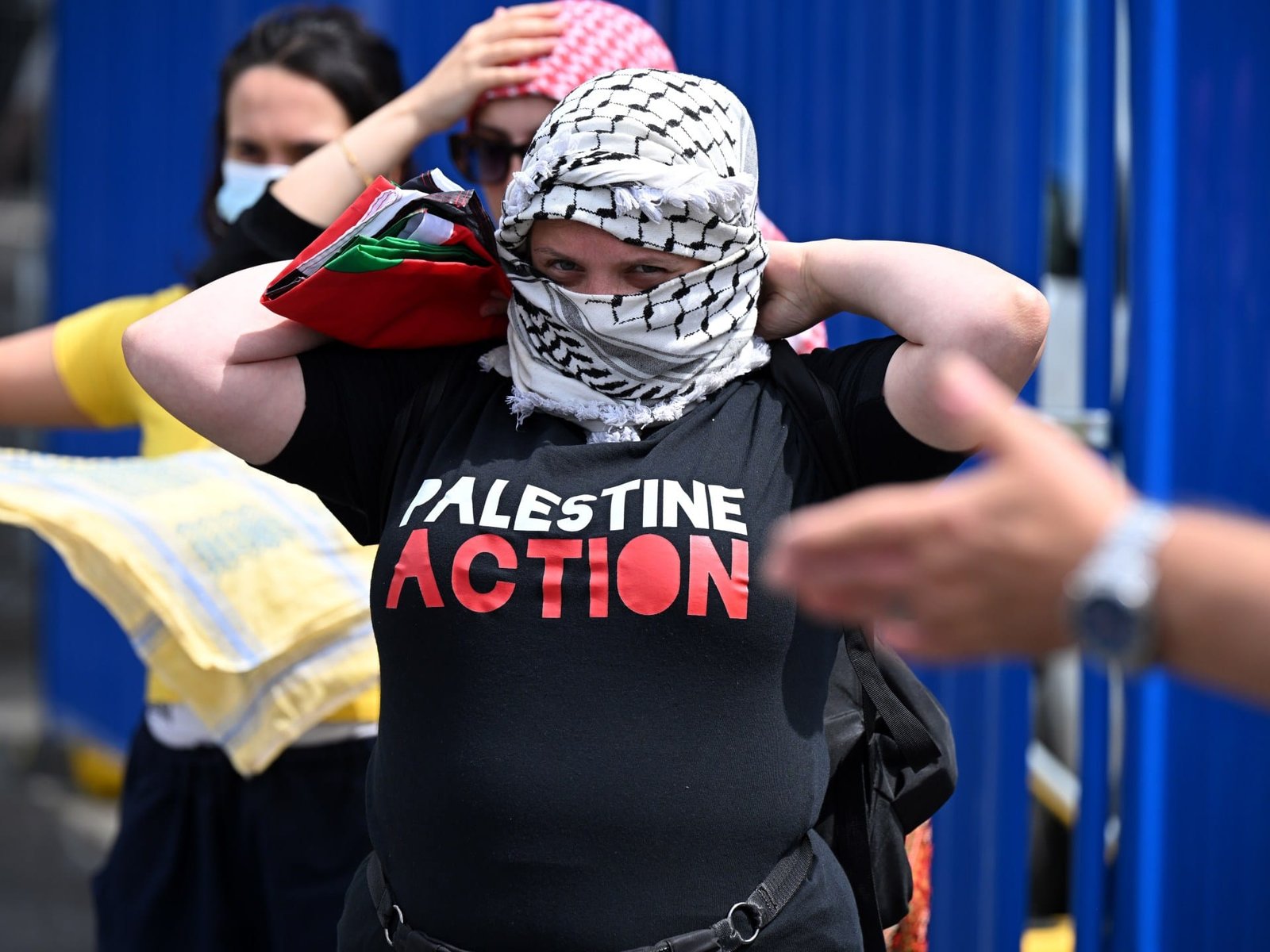
The UK government is seeking to proscribe the pro-Palestinian direct action group under anti-terrorism laws.
The United Kingdom said on June 23 that it would ban a pro-Palestinian campaign group called Palestine Action under anti-terrorism laws. This would put the organisation on par with armed groups like al-Qaeda and ISIL (ISIS) in the UK, making it a criminal offence to be part of Palestine Action.
The government’s announcement has prompted criticism from human rights organisations and triggered protests. On Tuesday, 13 people were arrested and seven were charged after protesters in London clashed with Metropolitan Police officers. The charges included assaulting emergency workers and a racially aggravated offence.
Palestine Action describes itself as a movement “committed to ending global participation in Israel’s genocidal and apartheid regime”. The group was launched in July 2020.
The group says it seeks to use “disruptive tactics” to target “corporate enablers” and companies involved in weapons manufacture for Israel, such as Israel-based Elbit Systems, Italian aerospace company Leonardo, French multinational Thales and United States company Teledyne. The group has targeted British facilities linked to these companies.
“Palestine Action is a direct action group who have majoritively focused on weapons factories that are operating on British soil and are complicit in the current genocide in Gaza, but also in the longer-term kind of oppression of the Palestinian people,” Manaal Siddiqui, a spokesperson for Palestine Action, told media.
In 2022, the group broke into a Thales equipment factory in Glasgow, causing damage to weapons worth more than 1 million pounds ($1.4m).
Cooper’s statement came days after June 20, when some Palestine Action activists broke into RAF Brize Norton, the largest station of the Royal Air Force in Oxfordshire, and sprayed two military planes with red paint.
In the most high-profile move made by the group so far, the activists sprayed red paint into the turbine engines of two Airbus Voyager aircraft, used for air-to-air refuelling, and damaged them with crowbars.
British Prime Minister Keir Starmer condemned the incident in an X post the same day. “The act of vandalism committed at RAF Brize Norton is disgraceful,” he wrote.
The police have said the Palestine Action activists’ action resulted in millions of pounds of criminal damage.
“The disgraceful attack on Brize Norton in the early hours of the morning on Friday 20 June is the latest in a long history of unacceptable criminal damage committed by Palestine Action,” Cooper said in her Monday statement.
What is Palestine Action?
Siddiqui, however, said Brize Norton stores aircraft “which are going to be used around the world, but particularly in Gaza”. She added that they have also been used in Syria and Yemen.
Israel’s war in Gaza, which began on October 7, 2023, has killed more than 56,000 Palestinians.
“The amount of aid being dropped is an absolute drop in the ocean,” Siddiqui said, adding that the UN says about 2,300 tonnes of aid are required to meet Gaza’s daily needs.
In a statement posted on its X profile on Tuesday, Palestine Action said: “The real crime here is not red paint being sprayed on these warplanes, but the war crimes that have been enabled with those planes because of the UK government’s complicity in Israel’s genocide.”
The statement also accuses Starmer of “hypocrisy” since the PM, back in 2003, supported protesters who broke into an RAF base to stop US bombers heading to Iraq. At the time, Starmer was a lawyer.
“I think it’s a very knee-jerk reaction from an embarrassed government, and it’s an overblown reaction,” Siddiqui said.
Siddiqui said it was unprecedented for Palestine Action to face the ban. “The majority of the proscribed groups are international. The majority of them take actions in very, very different ways. Palestine Action would be a complete outlier. It’s a Draconian approach for the government to stifle protests that they just don’t like. It’s genuinely terrifying for anyone who cares about civil liberties in the UK.”
In all, 81 groups are proscribed in the UK under the Terrorism Act 2000. They include political movements with armed wings, like Hamas and Hezbollah, as well as armed groups like ISIS (ISIL), al-Qaeda and Tehreek-e Taliban Pakistan.
On Monday, Sacha Deshmukh, chief executive of Amnesty International UK, said in a news release: “The UK has an overly broad definition of terrorism and proscribing a direct-action protest group like Palestine Action risks an unlawful interference with the fundamental rights of freedom of expression, association and peaceful assembly.”
He said regular criminal law and appropriate human rights protections were adequate to respond to direct action protesters such as those affiliated with Palestine Action.
Deshmukh added that the decision to ban Palestine Action risks “the free speech rights of many other activists who are deeply concerned about the plight of Palestinians in the context of Israel’s ongoing genocide in Gaza”.
London-based advocacy organisation CAGE International has also reacted to the announcement. In a statement published on its website, Naila Ahmed, head of campaigns at CAGE International, said: “We stand in absolute solidarity with Palestine Action in their campaign to dismantle the Zionist war machine and bring an end to the genocide in Gaza. Terrorism and proscription laws are now brazenly enabling the continuation of a livestreamed genocide.”


 United Arab Emirates Dirham Exchange Rate