
European leaders are meeting in Paris for an emergency summit to discuss how to respond to United States President Donald Trump’s decision to hold talks with Russia to end the Ukraine war without European involvement.
Monday’s meeting in the French capital follows the Munich Security Conference, which ended on Sunday, where US Vice President JD Vance reiterated Trump’s stance that Europe must increase its defence spending.
In January, Trump called on NATO’s European members to allocate 5 percent of their gross national products (GDPs) to defence. NATO Secretary-General Mark Rutte has also encouraged member states to increase their defence spending.
Global military spending hit $2.44 trillion in 2023, or $306 per person, marking a 6.8 percent increase from the previous year, according to the Stockholm International Peace Research Institute (SIPRI). This was the largest year-on-year rise since 2009.
By comparison, in 2000, global military expenditures were $798bn, or $130 per capita – less than a third of the amount spent today.
Global military spending is the total money spent by countries on their military forces and related activities. This includes costs for soldiers, operations, weapons, equipment, research and military infrastructure.
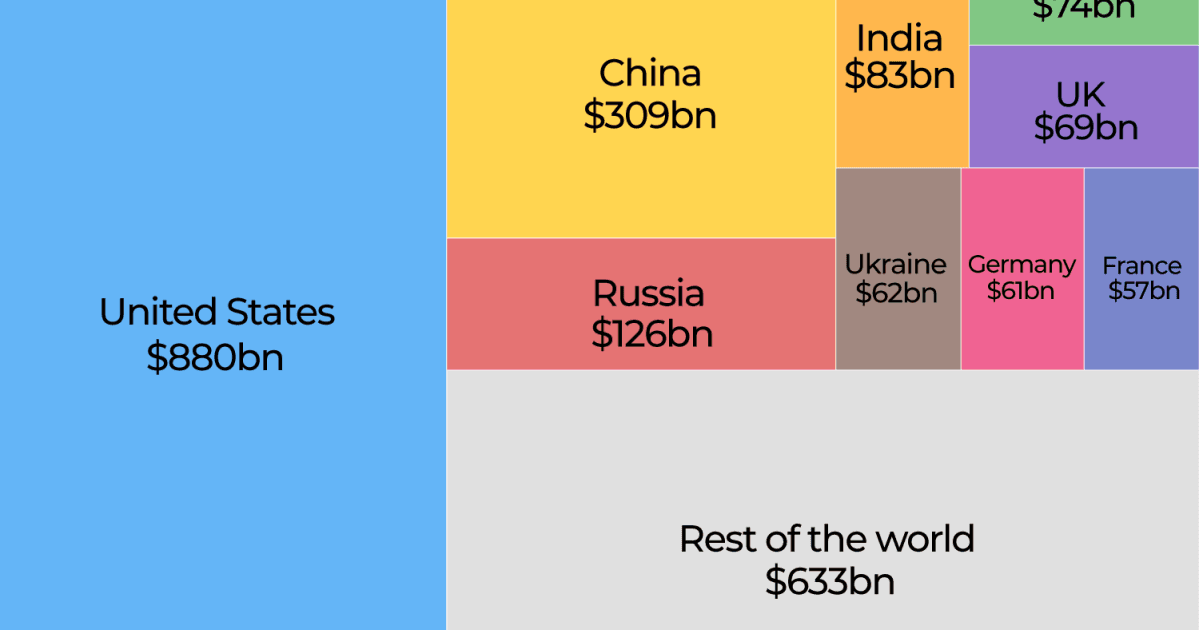
The US is the largest military spender in the world. In 2023, it paid out $880bn – more than the next eight countries combined, according to SIPRI.
China is the second highest spender with $309bn, followed by Russia at $126bn, India at $83bn and Saudi Arabia at $74bn.
The table below shows the total military spending for each country worldwide as well as their per capita spending and spending as a share of their GDPs and government budgets. Click on the columns to sort the table from highest to lowest.


 United Arab Emirates Dirham Exchange Rate