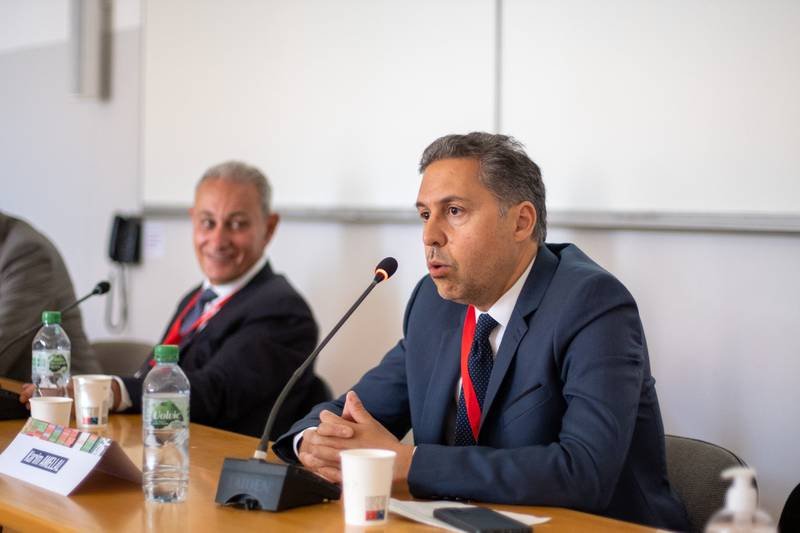
French envoy Karim Amellal says Paris is ‘sparing no effort’ to avoid escalation but is ‘very worried’ about Lebanon.
Live updates: follow the latest on Israel-Gaza
France is ‘very concerned’ over the threat of regional escalation as fighting between Israel and its sworn enemy Hezbollah along Lebanon’s southern border has intensified in recent weeks, a French top diplomat told media.
“The risk of an escalation is very important; diplomatic channels should prevail so that Lebanon is preserved from the opening of a new front in the south,” France’s Ambassador for the Mediterranean Karim Amellal said.
Hezbollah, a powerful Iran-backed Lebanese militant group and political party, opened a pressure front against Israel on October 8, with the stated objective of supporting its ally Hamas and diverting Israeli forces from their offensive against the Palestinian militant group in Gaza.
In recent weeks, Israel has grown more aggressive in its attacks against Hezbollah along the disputed Israel-Lebanon border, threatening to launch a major military operation unless a long-term border agreement is achieved.
“I can tell you that the likelihood of [a war] happening in the coming months is much higher than it was in the past,” Israel’s military chief Herzi Halevi said last week.
‘We are very concerned about these statements: they do not seem to be conducive to a resolution through diplomatic means,” Mr Amellal said.
Israel wants Hezbollah’s elite forces to pull back 40 kilometres from the UN-demarcated border and the creation of a buffer zone to allow the safe return of tens of thousands of residents who were evacuated from the north because of the fighting.
The areas along both sides of the border have been turned into quasi militarised zones, mostly emptied of civilians amid daily exchanges of fire.
More than 200 people have been killed in Lebanon, according to an AFP tally. The majority of them were members of groups attacking Israel, but the toll includes at least 26 civilians, three journalists, two rescuers and a Lebanese soldier. On the Israeli side, 15 people have been killed in the northern border area, including nine soldiers and six civilians, according to the Israeli army.
Against this backdrop, US-led diplomatic efforts have been intensified to avert a full-scale war in Lebanon. France, the former colonial power which has kept close ties with Lebanon, has also been involved.
Several top French officials have visited Beirut in recent weeks including Foreign Minister Catherine Colonna and Bernard Emie, the head of Fance’s external intelligence service.
“France is not sparing its efforts,” said Mr Amellal.
He stressed that the risk of escalation was at all-time high for the entire region, including the Red Sea, where Iran-backed Houthi militants have launched attacks on ships to disrupt maritime trade in response to Israel’s war on Gaza.
“It was to avoid further escalation that President Emmanuel Macron decided not to join the strikes by the American-British coalition against the Houthis,” he said, referring to the US-led military strikes on Houthi positions in Yemen since January 11.
Mr Amellal praised what he called France’s “balanced approach” to the crisis sparked by Hamas’s unprecedented attack on October 7 in which about 1,200 people were killed in southern Israel.
More than three months months into its assault on Gaza in response, the Israeli army has caused mass destruction and killed more than 25,000 Palestinians – most of them women and children, according to local health authorities.
Mr Amellal said Paris strongly condemned the “terrorist” actions of Hamas, stressing France’s support for Israel as “a friendly and allied country.”





 United Arab Emirates Dirham Exchange Rate